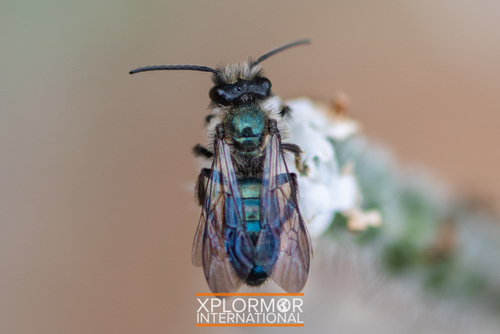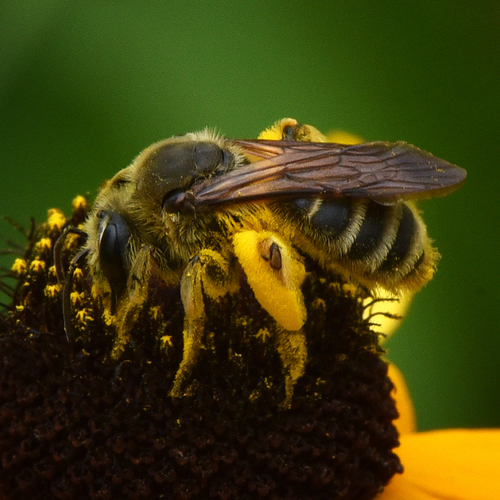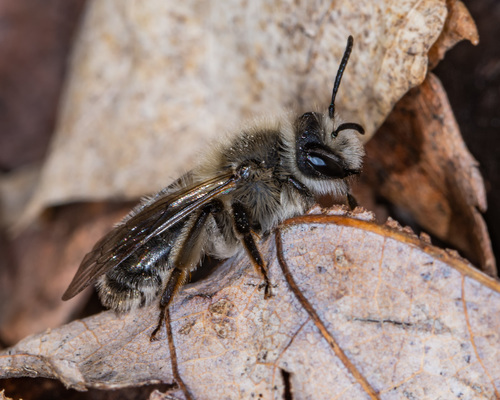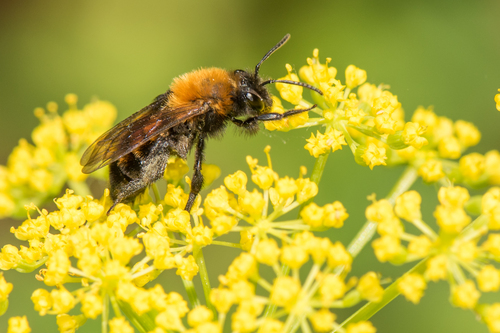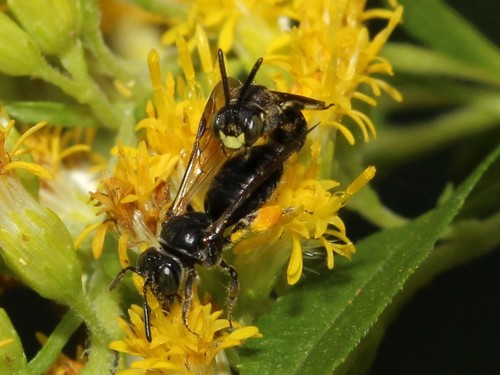
About Andrena barbilabris (Kirby, 1802)
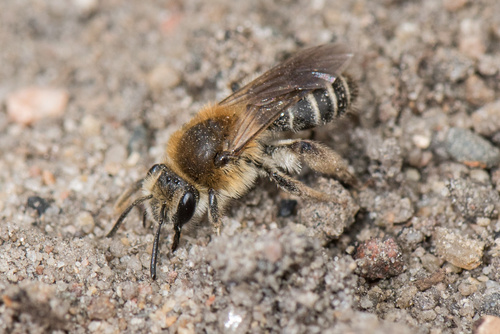
Description: Andrena barbilabris, commonly called the bearded miner bee, is typically around 11 mm long, with males smaller and slimmer than females. Females have rufous hairs on the dorsal surface of the thorax, which contrast with the yellower hairs on their head and thorax sides. Males often appear silvery in colour due to the long pale hairs covering their thorax. Most of the bee's integument is black. It has a narrow head that gives the species a distinctly hunch-backed appearance. Distribution: The bearded miner bee has a Holarctic distribution. Across North America, it occurs in southern Canada and the northern United States. In Eurasia, it ranges from western Europe east to Anatolia, extending into western and eastern Siberia, reaching the Russian Far East regions of Yakutia and Primorsky Krai, and is also found in Japan. In Britain and Ireland, it has a patchy, localised distribution that extends as far north as Inverness; it is scarcer in Ireland. It also occurs on the Channel Islands of Guernsey and Jersey. Habitat and ecology: The bearded miner bee is strongly associated with light, sandy soils. Males and females emerge from their underground cells in early spring. After emergence, they mate, and females then search for sites to excavate their nesting burrows. Inside each burrow, females dig out small cells and place a ball of pollen mixed with nectar in each cell. They lay a single egg on each pollen-nectar ball before sealing the cell closed. Nests are not easy to spot, and female bees rely on their sense of scent to locate their own nests. Nests are hidden under a thin layer of sand, and the bee can dig back into the nest in a short amount of time. The flight period of this species runs from March to July. Bearded miner bees forage on a wide variety of flowers, with willows being their preferred foraging plant, and they usually stay within 300 meters of their nests. Though classified as solitary bees, bearded miner bees form small nest aggregations in loose sandy soil, and will even nest between paving stones in gardens. Unlike other species in the genus Andrena, the presence of the specialized cleptoparasitic bee Sphecodes pellucidus (a member of the genus Sphecodes) often alerts observers to the presence of its bearded miner bee host; the cleptoparasite digs into sand to seek out and parasitize bearded miner bee nests.