About Andrena agilissima (Scopoli, 1770)
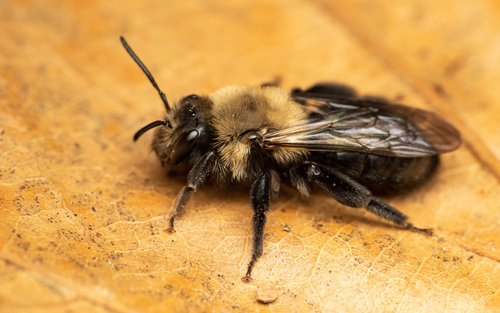
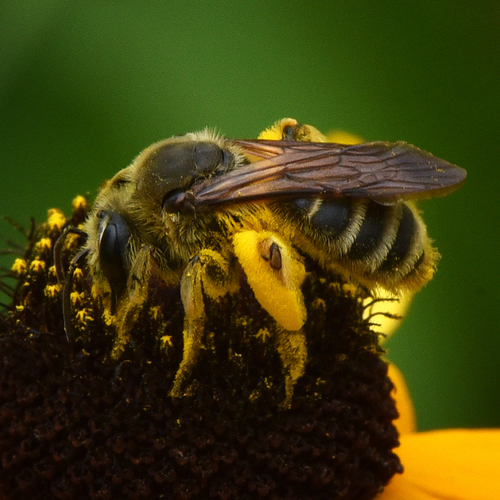
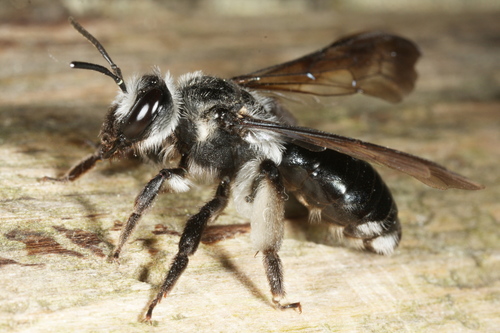
Andrena agilissima (Scopoli, 1770) is an oligolectic bee, which means it only collects pollen from a small number of flowering plant species. All pollen sources used by this bee belong to the Brassicaceae plant family, most commonly wild radish and wild mustard. This species shows a slight preference for foraging on wild radish. This is a pre-social springtime mining bee species. Females build their nests in earth walls, and collect pollen and nectar to provision the nest. This bee does not typically travel far from its nest, but has been observed foraging up to 300 meters away from its nesting site. Foraging activity on wild radish flowers peaks between 11:00 am and 1:00 pm. Adult Andrena agilissima reach a body length of 13–15 millimetres (0.51–0.59 in), and females are slightly larger than males. They have a shiny black body, with tufts of white velvety hairs on the facial fovea, both sides of the thorax, the last abdominal tergites, and the femora of the third pair of legs. Their wings display bluish reflections. This mining bee is native to southern and central Europe, ranging north to the Netherlands and Poland, south through Mediterranean islands to widespread North Africa, and east as far as the former territory of Czechoslovakia. It is absent from mainland Great Britain, but occurs on the Channel Islands. It is commonly called a hollow way bee, and requires a vertical surface for nesting. In Southern Germany, this bee collects pollen from wild mustard (Sinapis arvensis), which grows in open fields rather than on the vertical surfaces the bee uses for nesting. As a result, the species can only forage on this plant when fields are located close to suitable nesting sites. Shifts in agricultural landscapes across much of the species' range have caused population declines, and large nest aggregations are now rare. This decline also affects the cuckoo bee Nomada metalthoracica, which lays its eggs in Andrena agilissima nests. In south-west Germany, modified agricultural ploughing and planting practices have been introduced to support access to wild mustard for this bee. These changes have allowed Andrena agilissima to form metapopulations: groups of small local populations that experience local extinctions, new colonizations, and occasional dispersal between patches. Like Osmia brevicornis, Andrena agilissima feeds on Brassicaceae mustard plants. One large aggregation of this bee has been recorded on a 2.5 m high, 6 m wide earth wall in Tuscany, Italy.