About Andersonglossum virginianum (L.) J.I.Cohen
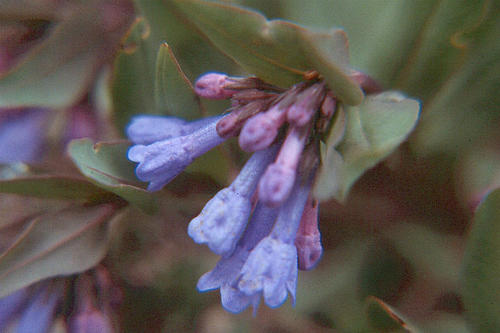
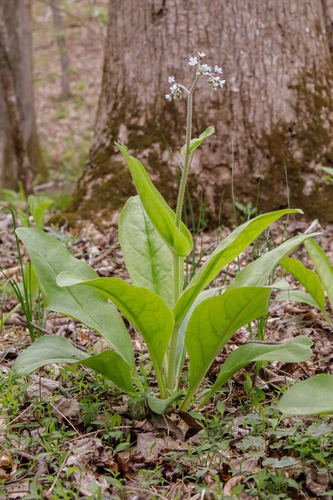
Andersonglossum virginianum (L.) J.I.Cohen is an erect, unbranched perennial plant covered in rough fine hairs on its stems and leaves. Its leaves are simple, entire, arranged in an alternate pattern, and grow denser at the lower portion of the stem, decreasing in size toward the top of the stem. It produces 2 to 6 racemes. Its flowers have five deep lobes, connected to a superior ovary that is attached to the style. The corollas are rounded, light blue, and overlap one another. Corollas alternate with stamens that bear anthers. It can be distinguished from the closely related Andersonglossum boreale: A. boreale has petioles on its cauline leaves, its corolla lobes are not rounded and do not overlap, and A. boreale is generally a smaller plant overall. A. boreale is currently disappearing from the southern part of its range in the United States. Many plants in the borage family, including Andersonglossum officinale, produce pyrrolizidine alkaloids, which are hepatotoxins that can affect grazing animals and humans, and this production is presumed to protect the plant from generalist herbivores. Botanists suspect that A. virginianum may also contain these alkaloids. Mature leaves measure 10–20 cm long and 2.5–7 cm wide; they are alternate, simple, entire, and not margined, decreasing in size up the stem toward the apical meristem. Flowers are 8–12 mm across, pale blue, with a superior, deeply four-lobed pistil. The sympetalous corolla is 5-8mm wide, light blue, formed into a short tube, with oblobed lobes that do not overlap. The calyx measures 1–3 mm. Each flower produces 1 to 4 nutlets, each 3.5-5mm, containing a single seed. Nutlets have a prickly, convex protruding horizontal surface and no margin. Andersonglossum virginianum is native to the Eastern United States, where it is abundant across the central and southeastern parts of the country. It is most often found in open uplands, with a recorded range extending from southern New England, west to New York and Illinois, south to Louisiana, Oklahoma, and Florida. Every year in spring around May, A. virginianum grows new above-ground foliage from a taproot. Non-flowering individuals produce additional leaves in a rosette, and the flowering stem emerges from the center of this rosette. This species is monoecious and self-compatible. It flowers from May to June, and produces fruits from July to August. Each flower forms four grayish brown seeds that adhere to animal fur for dispersal. In the 19th century, herbalists proposed that A. virginianum could be used as a substitute for Symphytum officinale (comfrey). Traditionally, it was used to treat wounds, flush out internal digestive disorders, treat respiratory infections, and act as a sedative. Like many borage family plants traditionally used medicinally, A. virginianum is now known to contain pyrrolizidine alkaloids, compounds that can cause acute and chronic liver damage as well as cancer. Modern herbalists recommend avoiding internal use of the plant, as well as avoiding large or extended doses.