About Anchusa strigosa Banks & Sol.
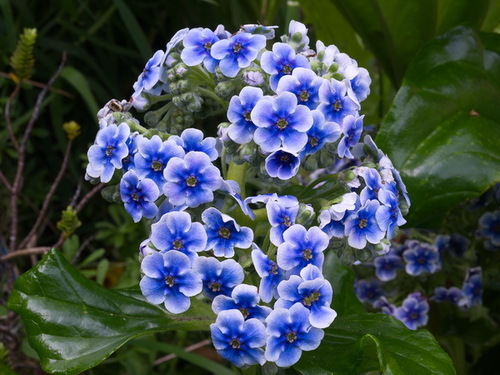
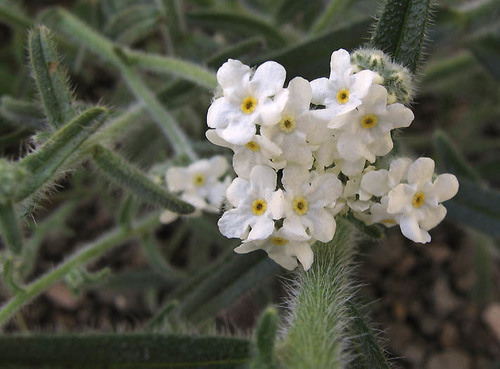
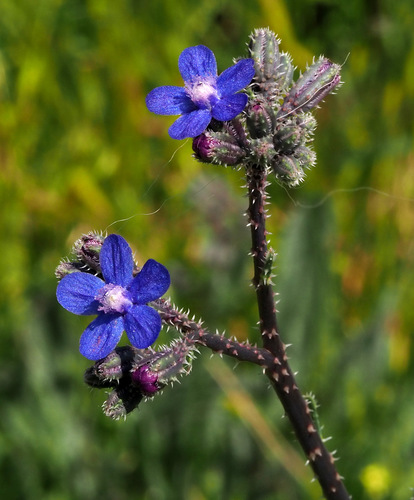
Anchusa strigosa Banks & Sol. is a perennial herb that grows a leaf rosette at its base, with an inflorescence stem that can reach 1 metre (3+1⁄2 ft) or more in height. Its leaves are rough, comparable to the tongue of a ruminant animal. In winter, the plant develops a large leaf rosette, and in late spring, several inflorescence stems grow from the plant's base. The petiole is nail-shaped, measuring 9 mm long; the flower has a narrow tube and a closed pharynx covered in bristly white scales. Most flowers are blue, though blue-flowered plants are gradually being displaced by a white-flowered variety. This species is native to the Old World, specifically the Eastern Mediterranean basin and adjacent Western Asia. It grows in heavy soils in semi-steppe shrublands, shrub-steppes, and Mediterranean woodlands. In Israel, its main habitat is the transition belt between the Mediterranean coastal region and arid desert regions, where it grows along waysides in sandy and chalkstone habitats. In Israel, flowers bloom between March and May. In Ottoman Palestine, honey bees collected the flower's pollen to make honey. The roots of Anchusa species, like those of Alkanna and Lithospermum, contain anchusin (also called alkanet-red), a red-brown resinoid colouring matter. Anchusin is insoluble in water, but soluble in alcohol, chloroform and ether. The red pigment was used as rouge in women's cosmetics to redden the cheeks. For some Anchusa species, the resinoid was collected and used for medicinal purposes. Gustaf Dalman, who carried out geographical and ethnographic research in Palestine in the early 20th century, recorded that the plant called lisān eth-thōr in the region was an edible wild herb. Dalman identified this plant as A. officinalis, noting that indigenous Arab peoples of the area collected its young spring leaf growth, boiled it before eating. After boiling, the leaves are finely chopped and sautéed in oil and garlic, then used as a meat garnish or as a dish served with eggs. The Greek physician and botanist Dioscorides (c. 40–90 CE) mentioned the medicinal properties of Anchusa (Greek: ἄγχουσα) in his work, adding that "the ointment makers use the root for thickening ointments." An ointment made from crushed leaves of the plant mixed with olive oil can be used to cure burns and skin lesions. The Jewish philosopher and physician Maimonides (1138–1204 CE) mentions the genera Lingua Bovina ("ox-tongue") in his Guide to Good Health (Regimen Sanitatis), describing it as "a proven light drug used in compound decoctions" when its leaves are dried, ground into powder, and infused in hot water.