About Anchusa officinalis L.
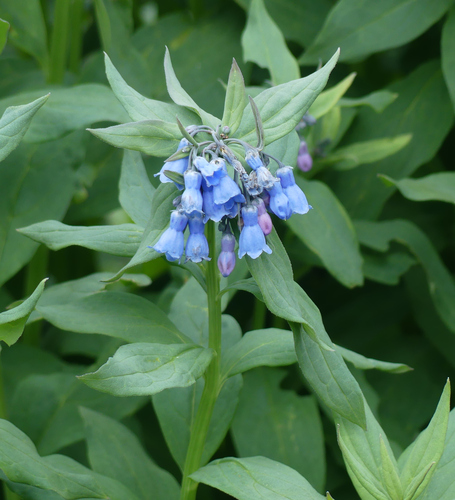
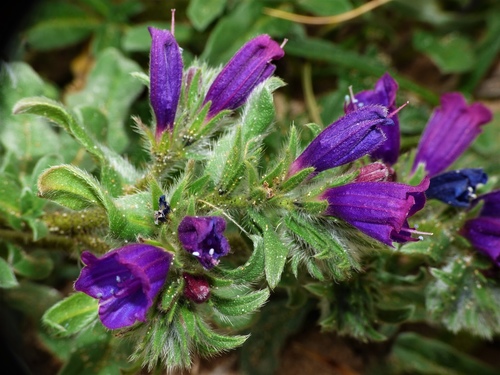
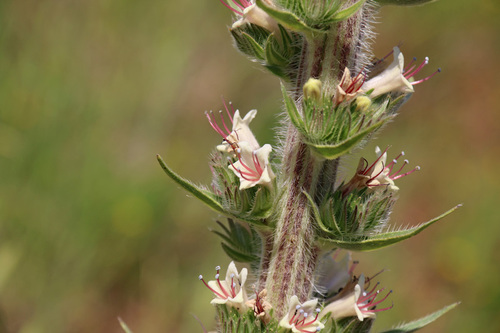
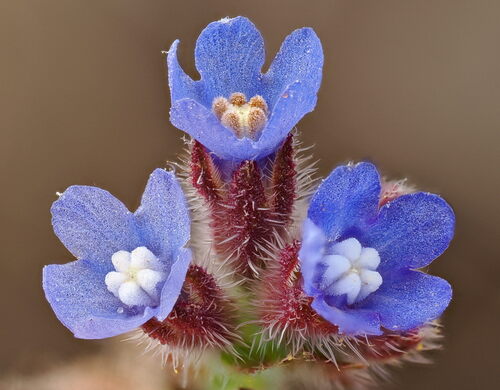
Anchusa officinalis L. is a herbaceous flowering plant that usually grows 40 to 70 centimeters tall, and can reach 100 centimeters tall under ideal conditions. It can grow as an annual, biennial, or perennial plant, and its entire surface is covered in short, coarse hairs. It has a strong taproot that may grow up to one meter long. Its leaves are lance-linear (narrow spearhead-shaped), widest at the middle and tapering toward both ends. Lower stem leaves have their own petioles (leaf stems), while leaves near the stem ends have bases that clasp the stem. Leaves are arranged alternately along the stem, and measure 6–20 centimeters long and 1–2.5 centimeters wide. Densely flowered terminal cymes (flowering clusters) hold blooms along one side of the stem. Newly opened flowers are dark pink or crimson, and typically turn dark purple-blue with a white center as they age; flowers may also be violet, reddish, white, or yellowish. The fused corolla (petal structure) is 6–11 millimeters long and 6–11 millimeters wide. The calyx (sepals) measures 5–7 millimeters long during blooming, and grows to 8–12 millimeters long when it persists through fruiting. The white center of the flower is made of scales that close the flower throat. In Europe, this species flowers from June to August. Its fruit is a nutlet, a hardened lobed ovary, that measures 2 millimeters wide and roughly 3–4 millimeters long. Each fruit can hold up to four seeds, but usually contains fewer. Anchusa officinalis flowers are self-incompatible, and require pollinator services to produce a good set of seed. Seeds mature and are produced from August to October. This species is native to Europe, from France extending into Russia west of the Ural Mountains, and south into Kazakhstan. It has been introduced to other parts of Europe, including the United Kingdom, Ireland, Belgium, and Finland. It has also been introduced to North America, where it occurs along the Pacific coast from British Columbia to California, in many Rocky Mountain states including Idaho, Montana, Utah, and Colorado, and in eastern North America in Connecticut, Illinois, Maine, Massachusetts, Michigan, New Hampshire, New Jersey, New York, Ohio, Ontario, Pennsylvania, Rhode Island, and Wisconsin. It also grows outside these regions in northeastern Argentina. Common alkanet grows in a range of habitats, including sandy grasslands in coastal dunes, wastelands that were once developed or farmed, shrub communities, slopes of former quarry sites, and along roadsides. Anchusa officinalis produces large amounts of nectar for pollinators. In a UK plant survey conducted by the Agriland project, it ranked ninth for annual nectar production per unit cover. Bumblebees and cuckoo bumblebees visit its flowers significantly more often than other bees, and often make up over 90% of all flower visitors. The common European bumblebee species Bombus subterraneus is specifically recorded as a pollinator of this plant. Females of the specialist bee Hoplitis adunca only collect pollen from flowers of the genus Echium, but they frequently visit other blue flowers like Anchusa officinalis to collect nectar. Nicholas Culpeper, whose work was popular despite many of his contemporary physicians viewing him as fraudulent, wrote about Anchusa officinalis under the names alkanet, orchanet, Spanish bugloss, and enchusa in his book The English Physician Enlarged, which had five printed editions before 1698. Culpeper claimed the plant had many medicinal virtues, including that it could cure snake bites, and made the extraordinary claim that if someone who had recently eaten the plant spits into a serpent's mouth, the serpent will die instantly. Before around 1810, European medical herbalism used the plant as an aperient and refrigerant, meaning as a laxative and fever-lowering treatment. However, physician and botanist William Woodville noted that since all common oleaceous plants are cooling and laxative, these properties are not a unique recommendation for bugloss. First-century Greek physician Pedanius Dioscorides recorded that the root of common bugloss has an astringent effect. He also stated that when the root is boiled in oil, it is effective for healing burns and old ulcers. Root preparations were also used externally to treat pain, soothe the skin, and promote wound healing. Late medieval botanist Hieronymus Bock recommended the plant to treat depression and strengthen the heart. Both Leonhart Fuchs and Bock wrote that it could be used to treat depression, but Woodville attributed any supposed effectiveness to the fact that it was typically administered in wine. Today, the plant is generally considered an obsolete medicinal remedy, due to the presence of pyrrolizidine alkaloids in its tissues.