About Anax imperator Leach, 1815
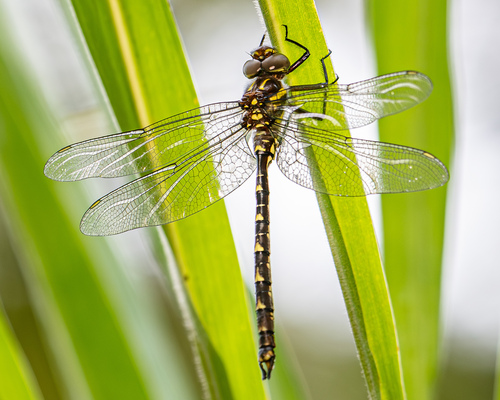
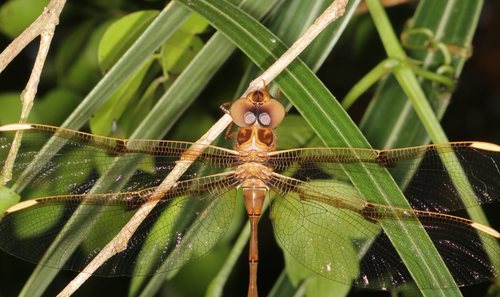
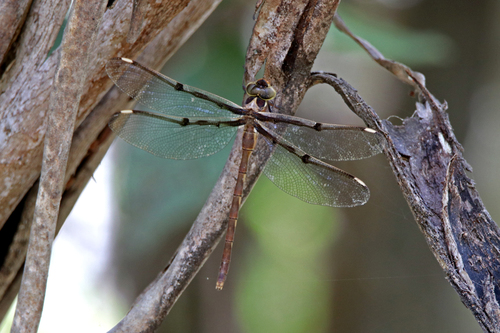
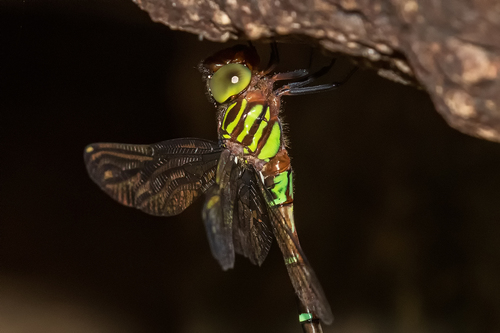
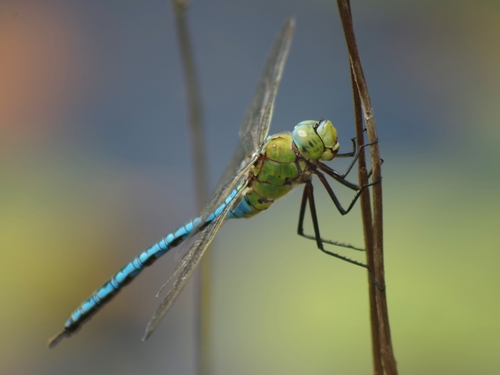
Identification: The emperor dragonfly (Anax imperator) is a large, bulky dragonfly species. Adults reach a total length of 73–82 mm (2.9–3.2 in), with an average length of 78 mm (3.1 in); males grow larger than females. The average adult wingspan is 104 mm (4.1 in). When individuals first emerge as adults, both sexes are pale green with brown markings. Their legs are brown with a yellowish base. Newly emerged wings are black, and darken to yellow-brown as the dragonfly matures. Mature males have a bright sky blue or turquoise abdomen marked with a distinct, diagnostic black dorsal stripe; this blue color may fade during periods of cold weather. A mature male’s thorax and head are apple green, and its prominent eyes are blue. Females have similar markings to males, but their base body color is a duller green. As females age, their wings become darker brown. Less obvious shared identification features include a yellow costa (leading wing vein) and brown spots on the wings. Emperor dragonflies can also be identified by their characteristic flight pattern: they typically fly with their abdomen hanging slightly downward. This is one of the largest dragonfly species in Europe. It is outmatched in size only by the magnificent emperor, which only occurs marginally in the eastern Mediterranean, and outmatched in length only by female golden-ringed dragonflies, a species that has an unusually long ovipositor. For this reason, the emperor dragonfly is the largest dragonfly species present across most of Europe. Distribution: This dragonfly has a wide distribution across Afroeurasia. It is found throughout Africa, across most of Europe, on the Arabian Peninsula, and in south-western and central Asia. Since the 1990s, the species’ range has expanded in Europe, moving both northward and to higher altitudes. The first confirmed record of the species in Scandinavia was in 1994, in Denmark. It was first recorded in Sweden in 2002, and first recorded in Scotland in 2004. Today, the species is regularly found in all three regions. This northward range expansion has been linked to global warming, and the emperor dragonfly is among the first odonates to expand its range in this way.