About Anas zonorhyncha Swinhoe, 1866
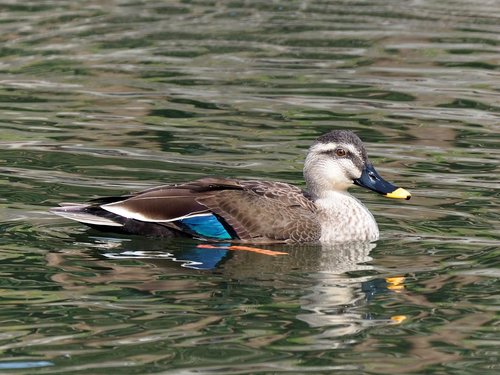
Anas zonorhyncha, the eastern spot-billed duck, is around the same size as a mallard, with a scaly patterned body and a blue speculum. When at rest, its long neck and yellow-tipped bill make it distinctive. This species measures 55–63 cm (22–25 in) in total length, 83–95 cm (33–37 in) across the wings, and has a body mass of 790–1,500 g (1.74–3.31 lb). Adults are mainly grey, with a paler head and neck, and a black bill tipped bright yellow. The underside of the wings is whitish with black flight feathers, while the upper wing surface shows a green patch bordered by white. Males of this species do not have an eclipse plumage. Juveniles are browner and duller in color than adult birds. The legs and feet are bright orange. Both male and female eastern spot-billed ducks produce calls similar to those of mallards: females give a loud quack, while males produce a deeper, quieter sound. The eastern spot-billed duck is darker and browner than the Indian spot-billed duck, and its body plumage is more similar to that of the Pacific black duck. Unlike the Indian spot-billed duck, it lacks a red spot on the bill, and has a blue speculum. Both males and females undergo a complete postnuptial moult, dropping all their wing feathers at the same time. This species is migratory, and winters in southern China and possibly Southeast Asia. It is quite gregarious outside of the breeding season, and forms small flocks. Since the early 20th century, populations in Japan and the Russian Far East have expanded their range northwards by more than 500 km, possibly in response to global warming. It is occasionally recorded as a rare vagrant to the Aleutian Islands of Alaska. The eastern spot-billed duck lives on freshwater lakes and marshes in fairly open country. It feeds by dabbling for plant food, mainly during the evening or at night. Its breeding season varies with rainfall and water conditions, but normally falls between April and July. It nests on the ground, in vegetation near water. Clutches usually contain 7–9 eggs. Incubation begins after the last egg is laid, which allows all chicks to hatch at the same time. The young hatch after around 24 days of incubation. Newly hatched chicks are black with a yellow back; they resemble mallard chicks, but have a wider eyestripe.