About Anas rubripes Brewster, 1902
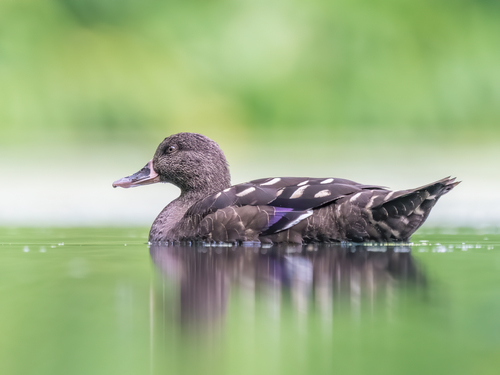
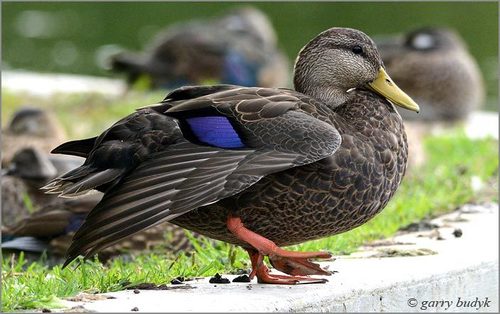
Description: The American black duck has a body mass of 720–1,640 g (1.59–3.62 lb), a total length of 54–59 cm (21–23 in), and a wingspan of 88–95 cm (35–37 in). This species has the highest average body mass among all members of the genus Anas. In a sample of 376 males, average body mass was 1.4 kg (3.1 lb), and 176 females had an average mass of 1.1 kg (2.4 lb). Even with this higher average mass, the typical size of the American black duck is very similar to that of the well-known mallard. The American black duck is somewhat similar in coloration to the female mallard, but the American black duck's plumage is darker overall. Males and females are generally alike in appearance, though males have yellow bills while females have dull green bills with dark markings on the upper mandible, which is occasionally flecked with black. The head of the American black duck is brown, and is a slightly lighter shade than the darker brown body. The cheeks and throat are streaked brown, with a dark stripe running through the crown and past the dark eye. The speculum feathers are iridescent violet-blue, with mostly black margins. The duck's feet are fleshy orange with dark webbing. Both male and female American black ducks make calls similar to their close relative the mallard; females produce a loud sequence of quacks that decrease in pitch. When in flight, the white lining of the underwings is visible in contrast to the blackish underbody and upperside. The purple speculum has no white bands on its front or rear edges, and only rarely has a white trailing edge. A dark crescent can be seen on the median underwing primary coverts. Juveniles look similar to adult females, but have broken narrow pale edges on their underpart feathers. This gives juveniles a slightly streaked appearance, rather than the scalloped pattern seen in adults, and the overall color is browner instead of uniformly blackish. Juvenile males have brownish-orange feet, while juvenile females have brownish feet and a dusky greyish-green bill.
Distribution and habitat: The American black duck is endemic to eastern North America. In Canada, its range stretches from northeastern Saskatchewan to Newfoundland and Labrador. In the United States, it occurs in northern Illinois, Michigan, New Jersey, Ohio, Connecticut, Vermont, South Dakota, central West Virginia, Maine, and along the Atlantic coast down to North Carolina. The American black duck is a habitat generalist, and is associated with tidal marshes. It is present year-round in salt marshes from the Gulf of Maine to coastal Virginia. It usually prefers freshwater and coastal wetlands across northeastern America, including brackish marshes, estuaries, and edges of backwater ponds and rivers lined by speckled alder. It also lives in beaver ponds, shallow lakes with sedges and reeds, bogs in open boreal and mixed hardwood forests, and forested swamps. Populations in Vermont have also been recorded in glacial kettle ponds surrounded by bog mats. During winter, the American black duck mostly lives in brackish marshes bordering bays, agricultural marshes, flooded timber, agricultural fields, estuaries, and riverine areas. To escape hunting and other disturbances, American black ducks usually take shelter by moving to brackish and fresh impoundments located on conservation land.