About Anas poecilorhyncha J.R.Forster, 1781
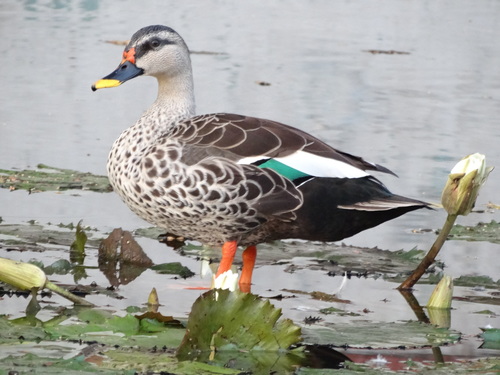
This species of duck, Anas poecilorhyncha J.R.Forster, 1781, is roughly the same size as a mallard. It has a scaly patterned body and a green speculum bordered by white. When the bird is at rest, the white border stands out. For the nominate subspecies, the long neck, yellow-tipped bill, and orange-red spots at the base of the bill are distinctive. In flight, the species can be identified by the green speculum with a broad white band at its base. The subspecies haringtoni lacks the red spots at the base of the bill. This duck measures 55–63 cm (22–25 in) in total length, 83–95 cm (33–37 in) across the wings, and has a body mass of 790–1,500 g (1.74–3.31 lb). Most individuals are mainly grey, with a paler head and neck, and a black bill tipped bright yellow. The undersides of the wings are whitish with black flight feathers, while the upper sides show a green speculum bordered by white. Males have a red spot on the base of the bill; this spot is absent or inconspicuous in females, which are smaller but otherwise similar to males. Males of this species do not have an eclipse plumage. The legs and feet are bright orange to coral red. Juveniles are browner and duller in color than adult birds. The eastern spot-billed population (or taxon) of this species is darker and browner, with body plumage more similar to the Pacific black duck. It lacks the red bill spot, and has a blue speculum instead of green. Both male and female birds undergo a complete post-breeding moult, dropping all their wing feathers at the same time. This duck is a resident species across Pakistan and India, where it lives in freshwater wetlands. It tends to avoid very large areas of open water, and prefers medium-sized wetlands with vegetation cover. However, some individuals do migrate; one bird ringed at Bharatpur in Rajasthan on 5 December 1969 was recovered near Novosibirsk in August 1970. Outside of the breeding season, this duck is quite gregarious and forms small flocks. Since the early 20th century, the northernmost populations of this duck have expanded their range northwards by more than 500 km, which may be a response to global warming.