About Anas laysanensis Rothschild, 1892
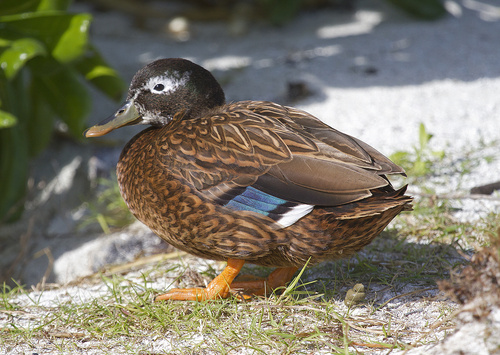
The Laysan duck (Anas laysanensis Rothschild, 1892) is a duck species that reaches teal size, with an overall dark brown plumage and a distinct, prominent white eye-ring. Its bill is short and spatulate: males have dark green bills with variable black blotching, while females have dull orange bills with variable black blotching. Most Laysan ducks have a ring of fat around their neck. Some males display faint iridescence on the head or neck, and have slightly upturned central tail feathers. Both sexes have an iridescent purplish-green patch, called the speculum, on their wings. Leucism, which causes extensive white feathering, is commonly seen on the head and neck of older birds. The legs and feet are orange, and are usually a brighter shade in males than in females. Laysan ducks go through a complete annual pre-basic molt: during this molt, they lose all their flight feathers and are unable to fly until new flight feathers grow in. Wild Laysan ducks have been recorded living up to 12 years of age, while captive individuals have lived up to 18 years.
For reproduction, pair formation begins in autumn, and nest building starts in spring. Females build well-concealed ground nests under dense vegetation, most commonly in the bunchgrass Eragrostis variabilis. The nest is shaped like a shallow bowl, lined with dead grass and down feathers. Egg-laying typically takes place between April and August. On Laysan Island, the average clutch size is approximately four eggs. The more recently established population on Midway produces larger clutches, a difference that is presumed to stem from greater food availability there. Laysan duck ducklings are precocial. They begin feeding on their own by the second day after hatching, but the female hen guards, broods, and leads ducklings to foraging sites for roughly 40 to 60 days after hatching.