About Anas crecca Linnaeus, 1758
Anas crecca Linnaeus, 1758, commonly called the Eurasian teal, is one of the smallest living dabbling ducks. Adults measure 34–43 cm (13–17 in) in total length; breeding males (drakes) average 360 g (13 oz) in weight, while females (hens) average 340 g (12 oz). Wing length ranges from 17.5–20.4 cm (6.9–8.0 in), for a total wingspan of 53–59 cm (21–23 in). The bill measures 3.2–4 cm (1.3–1.6 in) long, and the tarsus measures 2.8–3.4 cm (1.1–1.3 in).
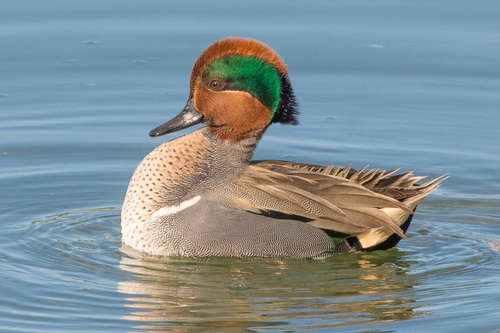
From a distance, breeding-plumage drakes appear grey, with a dark head, yellowish rear end, and a white stripe running along the flanks. Their head and upper neck are chestnut, marked with a wide, iridescent dark green half-moon or teardrop-shaped patch that starts just in front of the eye and curves to the upper hindneck. This patch is bordered by thin yellowish-white lines, and a single line of the same color extends from the front edge of the patch, curving along the base of the bill. The breast is buff with small round brown spots. The center of the belly is white, and the rest of the body plumage is mostly white with thin, dense blackish vermiculations, which makes it look medium grey even from a short distance. The outer scapular feathers are white with a black border on the outer vanes, and form the visible white side-stripe when the bird is at rest.
The primary flight feathers are dark greyish brown; the iridescent blackish-green speculum feathers have white tips, and form the speculum along with the yellowish-white tips of the larger upperwing coverts, which are otherwise grey. The underwing is whitish, with grey flight feathers, dense dark spotting on the inner coverts, and a dark leading edge. The tail and tail coverts are black, with a bright yellowish-buff triangular patch on each side of the central coverts.
In non-breeding (eclipse) plumage, the drake resembles the female more closely: it has more uniform coloration, a dark head, and only faint vestigial facial markings. Females are yellowish-brown, darker on the wings and back. They have a dark greyish-brown upper head, hindneck, eyestripe, and overall feather pattern. Their head and neck have dense short streaks, and the rest of their body has scaly spots; at rest, they closely resemble a small female mallard (A. platyrhynchos). Female wing coloration is similar to that of the drake, but upperwing coverts are brown instead of grey with narrower white tips, while speculum feathers have wider tips. Female tail feathers have yellowish-white tips, and the midbelly is whitish with some dark streaking.
Immature birds have coloration very similar to adult females, but with a stronger, more distinct pattern. Downy hatchlings match the typical coloration of other dabbling ducks: brown upperparts and yellow underparts, with a yellow supercilium. They can be recognized by their extremely small size, weighing just 15 g (0.53 oz) when they hatch.
The drake's bill is dark grey, and often has a light greenish or brownish tint at the base during eclipse plumage. The bill of females and immatures is pinkish or yellowish at the base, turning dark grey towards the tip; the grey area expands toward the base as the birds age. Males have dark grey feet, while females and immatures have greyish olive or greyish-brown feet. The iris is always brown in all individuals.
Moulting occurs during summer. Males in eclipse plumage resemble females, but have darker upperparts and a grey bill. Their flight feathers are moulted all at once, leaving the birds flightless for up to four weeks.
This is a noisy species. The male gives a clear, far-carrying whistle that sounds like cryc or creelycc, which is not very loud. The female produces a feeble quack that sounds like keh or neeh. Breeding-plumage males can be distinguished from drakes of the closely related green-winged teal by the presence of the horizontal white scapular stripe, the absence of a vertical white bar on the sides of the breast, and the more conspicuous light outlines around the green facial patch, which are indistinct in green-winged teal drakes. Eclipse-plumage males, females, and immatures are most easily recognized by their small size, vocalizations, and speculum, but they are very hard to tell apart from green-winged teal.
The Eurasian teal breeds across the Palearctic, and most individuals winter well south of their breeding range. In the milder climate of temperate Europe, summer and winter ranges overlap. For example, a small summer breeding population lives in the United Kingdom and Ireland, but far larger numbers of Siberian Eurasian teal arrive there in winter. The species can be found year-round in the Caucasus region, western Asia Minor, along the northern shores of the Black Sea, and even on the south coast of Iceland and the Vestmannaeyjar.
In winter, the species reaches high densities around the Mediterranean (including the entire Iberian Peninsula, extending west to Mauretania), in Japan and Taiwan, and across South Asia. Other important wintering locations include almost the entire length of the Nile Valley, the Near East and Persian Gulf region, the mountain ranges of northern Iran, and South Korea, continental East Asia, and continental Southeast Asia. More isolated wintering grounds include Lake Victoria, the Senegal River estuary, the swamps of the upper Congo River, the inland and sea deltas of the Niger River, and the central Indus River valley.
Vagrants have been recorded in inland Zaire, Malaysia, Greenland, and the Marianas, Palau, and Yap in Micronesia; they are regularly recorded on North American coasts south to California and South Carolina, including annual sightings on the island of Newfoundland. Tracking of wintering teal in Italy shows most individuals leave wintering grounds between mid-February and March, traveling the Black Sea-Mediterranean flyway to reach their breeding grounds from central Europe to east of the Urals by May. This slow migration is caused by long stopovers near the start of the route, mainly in southeastern Europe.
Overall, the Eurasian teal is much less common than its American counterpart, the green-winged teal, but it is still very abundant. Population counts are mostly done via surveys of wintering birds; around 750,000 are recorded annually around the Mediterranean and Black Seas, 250,000 in temperate western Europe, and more than 110,000 in Japan. A more detailed census in 1990 and 1991 counted over 287,000 wintering birds in Iran, around 109,000 in Pakistan, around 37,000 in India, 28,000 in Israel, over 14,000 in Turkmenistan, and almost 12,000 in Taiwan. The species is currently maintaining its population, after a slow annual decline of around 1–2% in the 1990s, which is thought to be caused mainly by wetland drainage and pollution. No conservation actions beyond continued population monitoring and possible improved habitat protection on wintering grounds are needed. The IUCN and BirdLife International classify the Eurasian teal as a species of Least Concern, an assessment that has not changed since the split from the more numerous green-winged teal (A. carolinensis). The Eurasian teal is one of the species covered by the Agreement on the Conservation of African-Eurasian Migratory Waterbirds (AEWA).