About Anartia fatima Fabricius, 1793
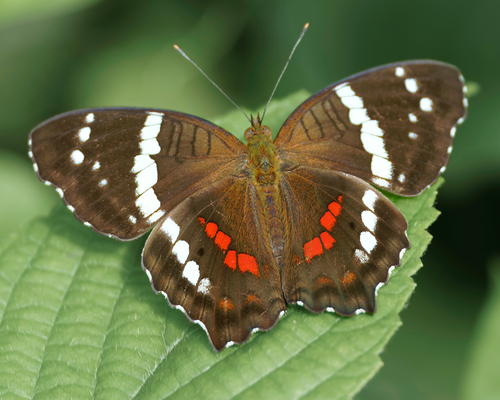
Anartia fatima, commonly known as the banded peacock, is a butterfly species belonging to the family Nymphalidae. It is commonly found in south Texas, Mexico, and Central America, and has been most heavily studied in Costa Rica. Although it has been recorded once as far north as Kansas, its core range starts in southern Texas and extends south through Mexico, all of Central America, and Panama. It does not occur in South America, where the closely related species Anartia amathea is prevalent instead, and it is common and widespread across its entire native range. This butterfly prefers subtropical climates and moist open areas, particularly near rivers. It spends most of its time in second-growth woodlands, and its general habitat includes previously disturbed open subtropical areas from sea level up to 1,500 meters. Small populations of the species can be found along river banks in large continuous forests, which suggests that individual banded peacocks can disperse across long distances. Its preferred host plants are herbaceous species, almost all belonging to the single family Acanthaceae; common examples of host plants include Blechum, Justicia, Dicliptera, and Ruellia. Larvae feed on Acanthaceae plants, while adult butterflies primarily feed on flower nectar from Acanthus species. While feeding on nectar from Acanthus and other plants, the butterflies act as pollinators, picking up and depositing pollen as they move between flowers. This species is diurnal. Banded peacocks face interspecific competition for nectar with other butterfly species, and also compete with hummingbirds, which will chase the butterflies away from nectar sources. Males exhibit territorial behavior from late morning to early afternoon: they perch on low vegetation and chase other male butterflies out of their territories, then fly in a slow zig-zag pattern between 0.3 and 0.6 meters above the ground to patrol their territory and search for females. Males seek mates within their territories, and also get most of their nutritional needs from flowers growing in these areas. Females lay eggs on the leaves and flower bracts of low-lying host plants. A single female can lay several hundred eggs over the span of a few days, but only a small percentage of these eggs survive to reach adulthood. Eggs hatch after five days, and larvae go through six instar phases before entering the pupal stage. Once pupation is complete, adult butterflies emerge and can fly away within 1 to 2 hours. This butterfly is not toxic to predators, and is preyed on by many species of birds, lizards, frogs, and arthropods. Because the species is so abundant and widespread, predation losses do not put the species at risk of endangerment.