About Anarta trifolii Hufnagel, 1766
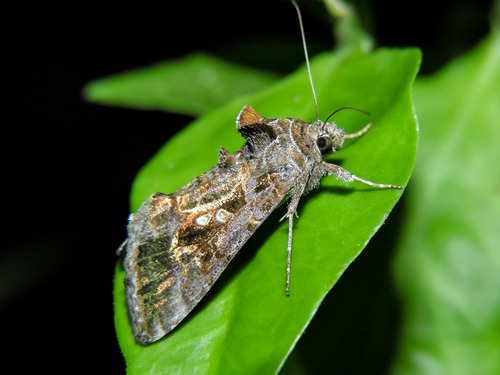
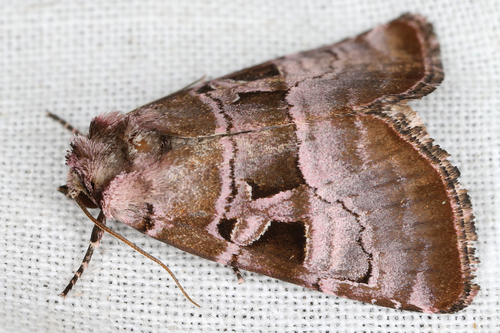
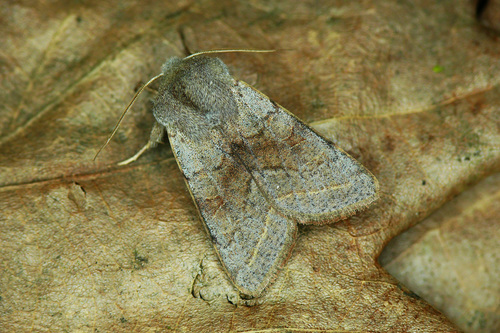
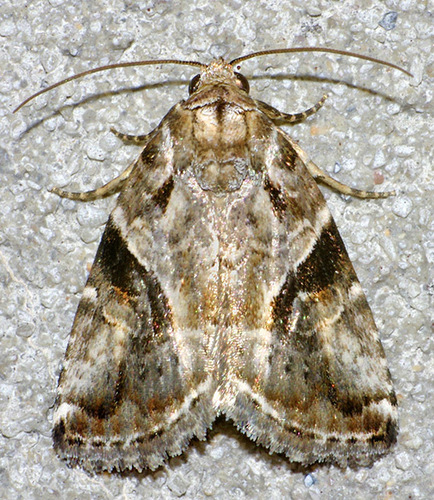
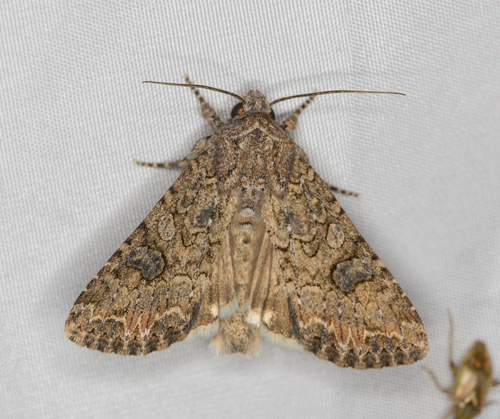
Anarta trifolii Hufnagel, 1766 is a small to medium moth species with a wingspan of 33–39 mm. Its forewings have cryptic coloration, ranging from light to dark brown and sometimes taking on a reddish tinge. The species’ most distinct characteristic feature is a clear, white W-shaped subterminal line; while this marking appears in some other noctuid moth species, it is typically found in much larger species. The hindwings of Anarta trifolii are grey or buff, darkening toward the termen, and marked with dark veins. Seitz’s description notes the forewing is grey with dark speckling, black spots along the costa, a small claviform stigma, a round, pale orbicular stigma that is sometimes whitish, and a large reniform stigma with a dark grey lower lobe; all three stigmata have fine black edges. Veins toward the termen are finely black, while the hindwing is dull whitish with a broad fuscous border and fuscous veins. Several forms and aberrations are recognized: the form saucia Esp. has a tendency toward an ochreous tint. In aberration farkasii Tr., the forewing is more variegated with light and dark patterning; the larger pale orbicular stigma and a pale patch lying obliquely below it form a prominent streak. Aberration indistincta Tutt has a uniform dull appearance with no speckling. The taxon albifusa Walk., currently treated as the subspecies A. t. albifusa (Walker, 1857) from Nova Scotia, was originally described from a North American specimen, but is considered likely a rare general aberration that has also been recorded at Portland on the chalky south coast of England. Specimens of albifusa are grey with a yellowish gloss, and have a pale band matching that seen in farkasii, joined by a second pale oblique band extending from the wing apex. The larva varies in color from green to brown, is covered in numerous small dark dots, has a fine pale dorsal line and broader subdorsal lines, all of which are edged with black, and has a broad yellow spiracular stripe that is mottled with reddish tones. This species is distributed across the Western Palearctic, including western Europe, Tunisia, and Iran, as well as Niger and Quebec in North America. In the northern portion of its European range, it only occurs as a summer migrant, and cannot survive the region’s cold winters. For a list of recorded food plants, see the original reference.