About Anaphalis margaritacea (L.) Benth.
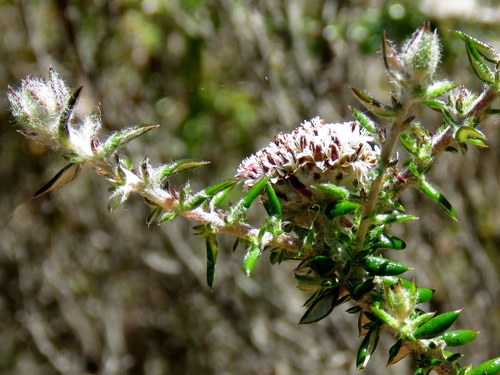
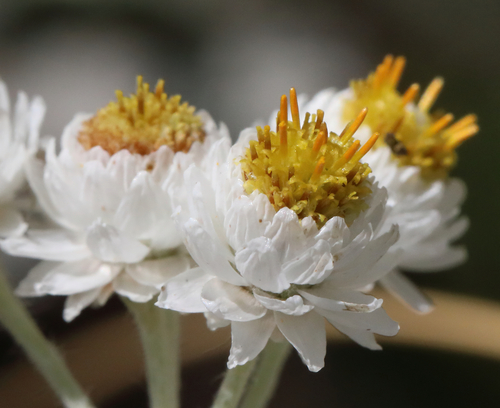
Anaphalis margaritacea (L.) Benth., commonly called western pearly everlasting, grows erect to around 90 centimetres (3 feet) tall. It produces narrow, alternate leaves that can reach up to 12.5 cm (5 inches) in length; the undersides of these leaves are densely covered in tiny hairs. Its stems are dry and brittle. Individual whitish to yellowish flowers grow to about 6 millimetres (1⁄4 in) across, and are arranged in a corymb inflorescence. The most noticeable feature of the inflorescence is the many pearly white bracts that surround the disc florets. This species blooms between June and September, and is dioecious: pollen-producing male flowers and seed-producing female flowers grow on separate individual plants. It is widespread across most of Canada and the United States, and also occurs in northwestern Mexico. In Asia, native populations are found in China, the Russian Far East, Japan, Korea, northern Indochina, and the Himalayas. The species is reported to be naturalized in Europe, where it is not native. It prefers dry, sunny climates, and is hardy to temperatures well below freezing. The leaves of Anaphalis margaritacea act as a host plant for caterpillars of the American painted lady butterfly (Vanessa virginiensis) and the painted lady butterfly (Vanessa cardui). Western pearly everlasting is sometimes cultivated by gardeners for its attractive foliage and softly attractive white blooms. Cultivated plants grow best in well-drained, somewhat sandy, dry soil with low organic matter content. They require at least partial sun, if not full sun, to grow successfully. In optimal growing conditions, they can become somewhat aggressive spreaders. The dried flowering stems of western pearly everlasting, with their fluffy flower heads, are used in dried flower arrangements. Its leaves and young plants are edible when cooked.