About Anaphalioides bellidioides (G.Forst.) Glenny
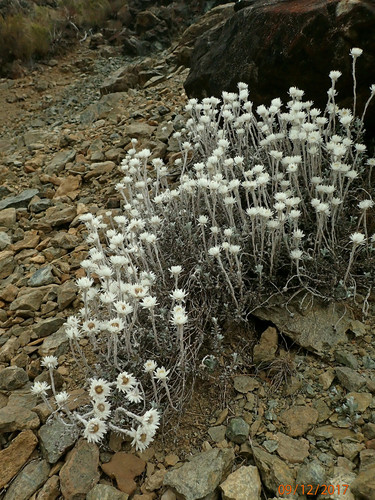
The scientific name Anaphalioides bellidioides means "resembling Bellis", a daisy genus that includes the common lawn daisy Bellis perennis. This species, commonly called the everlasting daisy, is a small, low-growing shrub with trailing shoots that can reach up to 50 cm (20 in) long. It grows in a prostrate form, with roots attaching to the soil substrate at points along its trailing shoot system. Its leaves are closely spaced along the stems and range in color from grey to green. The upper surface of mature leaves is glabrous (hair-free), while the underside is covered in soft white fuzz. Leaves are rounded and broad, measuring 5 mm–6 mm × 2 mm–4 mm (0.197 in–0.236 in × 0.079 in–0.157 in), ending abruptly in a sharp point at the apex. Leaf stalks are wedge-shaped and semi-amplexicaul, meaning they partially clasp the stem. The everlasting daisy produces red-brown scapes (flower stalks) that grow directly from the root, reach approximately 37–105 mm (1.5–4.1 in) long, and are covered in small bracts (scales). Each scape bears a single mature inflorescence around 2–3 cm (0.79–1.18 in) in diameter. The flower head is made up of 106–212 hermaphrodite florets, each around 4 mm (0.16 in) across, surrounded by outer bracts. The center of the flower head is yellow, and the outer petal-like structures are white with a papery texture. The plant’s branches, leaf undersides, and flower stems all have tomentum, a botanical term for a dense, fine woolly covering of matted hairs. Anaphalioides bellidioides is a variable species, with subtle phenotypic differences in leaf size and hairiness across different geographical locations and habitats. Anaphalioides bellidioides is endemic to New Zealand, and does not occur naturally anywhere else in the world. Within New Zealand, it is a common species with a wide distribution. In the North Island, it is found throughout the central and southern regions, including Gisborne, Taranaki, and the ranges around Wellington: the Kaimanawa, Kaweka, Ruahine, Rimutaka ranges, and Wairarapa. In the South Island, it is widely distributed across the full length of the island, occurring in Nelson, Marlborough, Westland, Canterbury, Otago, and Southland. It can also be found on many of New Zealand’s outlying smaller islands, including Stewart Island, the Chatham Islands, Auckland Islands, Campbell Island, and the Antipodes Islands. This species is commonly found across a range of environments, from mountain habitats to lower subalpine grasslands, in areas with open or low-density vegetation. Recorded habitats include scrub, tussock grasslands, riverbeds and morainic gravels, roadsides, burned-over forests, rock outcrops, and ultrabasic soils of mineral belts. As noted, leaf size and hairiness on the upper leaf surface are the two primary phenotypic traits that vary by habitat. On the sub-Antarctic Auckland and Campbell Islands, only larger, hairier-leaved variants of the species are found. The same larger, hairier form grows on mainland alpine areas and low-altitude streambeds; this similarity across these locations is thought to stem from population spread via downstream water dispersal. In the North Island and lowland areas of the South Island, a smaller variant is found, with smaller leaves that are typically more glabrous on the upper surface than the larger variant. In tussock grasslands and sub-alpine scrub, both phenotypic variants grow alongside each other. Researchers have concluded that these phenotypic differences do not require formal taxonomic recognition, as they are only variations in physical appearance rather than distinct taxonomic groups. Anaphalioides bellidioides is an evergreen perennial plant. Its flower heads develop in late spring to early summer, with flowering occurring from October to December. Like most members of the daisy family Asteraceae, this species produces pappate cypselae (small, thin, indehiscent dry seeds with a thin outer pericarp, crowned by a scaled or bristled calyx) that are dispersed by wind, a dispersal method called anemochory. In simple terms, the seeds are fluffy, and open flower heads make wind dispersal easy for the plant. This species can also be pollinated via insects, a method called entomophily. Observed pollinator visitors to its flower heads include the moth Dasyuris anceps, plus various beetle species (family Coleoptera), hoverfly species (family Syrphidae), and tachinid fly species (family Tachinidae). These insect visitors act as pollinators (not predators) and transfer pollen between individual plants of the same species.