About Anania hortulata Linnaeus, 1758
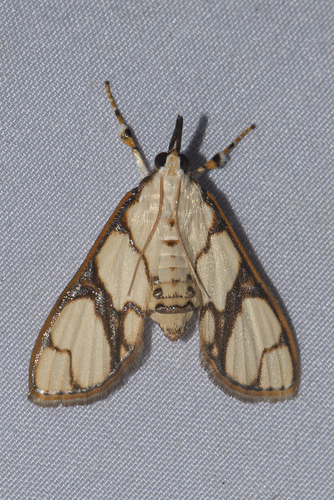
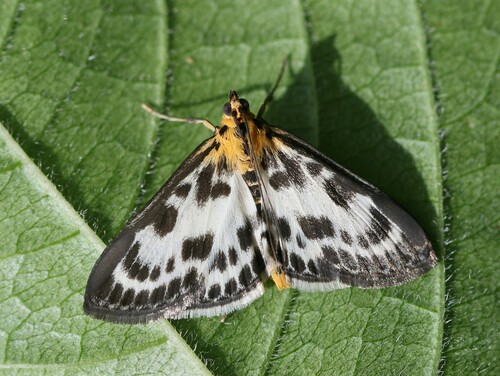
Anania hortulata (Linnaeus, 1758) has a wingspan ranging from 24 to 28 millimetres (0.94 to 1.10 inches). Its head and thorax are deep ochreous-yellow and marked with black spots. The forewings are yellowish-white, with blackish markings; the base of the forewings is blackish and bears two ochreous-yellow marks, plus a suffused costal streak. The forewing lines are thick: the first line is irregular, while the second is curved, tends to form spots, and is narrowest below the middle. The forewings have a small orbicular spot and a large round discal spot, both of which touch the costal streak. There is also a terminal fascia that tends to form spots, with an edge running parallel to the second line. The hindwings match the forewings in base colour, and share the same second line and terminal fascia; they also have a blackish discal spot. Fully grown larvae are whitish, with a dull green dorsal line edged in white; their head and the second body segment’s plate are black. This moth flies from June to July, with flight timing varying by location. It can be easily disturbed during the day, and will also begin flying at dusk and come to light. Most eggs are laid on stinging nettle (Urtica dioica), with occasional oviposition on Labiatae species including white horehound (Marrubium vulgare), woundwort (Stachys species) and mint (Mentha species). Larvae are active in August and September, feeding inside a rolled or spun leaf. They overwinter inside a transparent cocoon, hidden under loose bark or inside the hollow stem of an Umbelliferae species such as common hogweed (Heracleum sphondylium). Pupation occurs in spring, within the site the species used for overwintering. This moth has been recorded in Europe, Asia, and North America; it is considered an exotic species in both Canada and the United States. For additional information see Parsons et al.