About Anania fuscalis (Denis & Schiffermüller), 1775
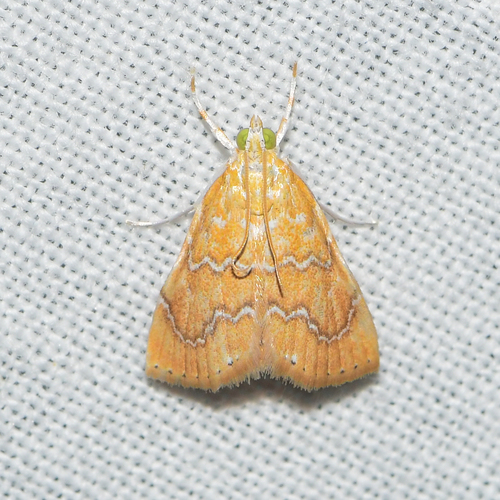
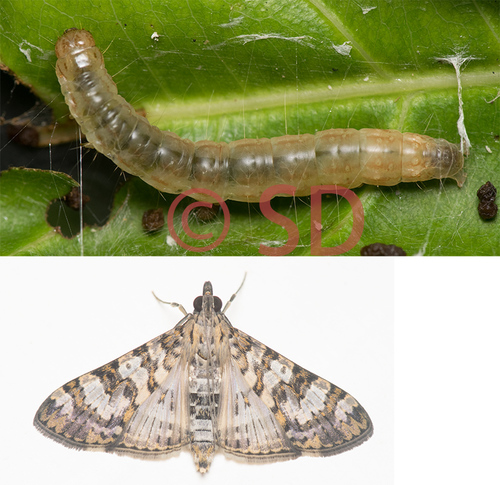
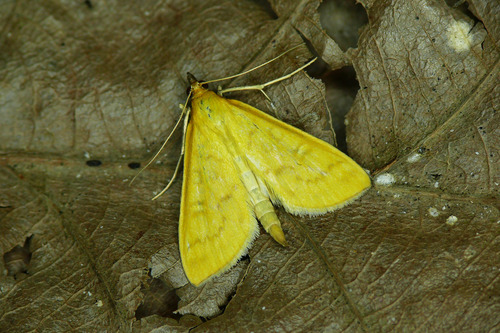
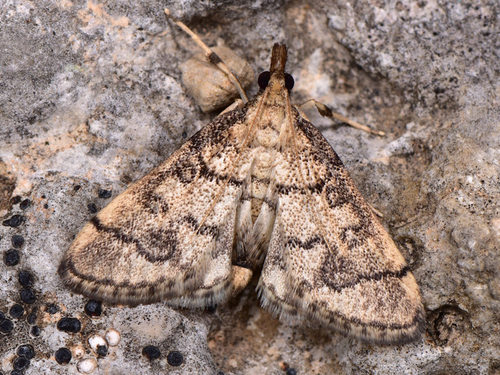
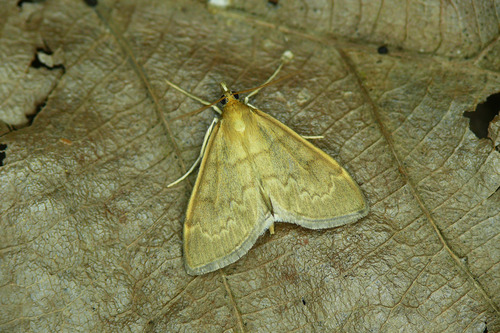
Anania fuscalis is a species of moth in the family Crambidae, found in Europe. This moth has a wingspan of 20–26 mm. Its forewings are grey with a slight yellowish tinge. The lines on the forewings are darker grey: the first line is indistinct and only barely curved, while the second line is serrate, strongly curved across the wing disc, and has an abrupt inward sinuation below its middle. The second line is obscurely edged with white on its posterior side, with stronger edging along the costa. Both the orbicular dot and the transverse discal mark are darker grey and indistinct. The hindwings are pale grey with a yellowish tinge, marked with two very faint discal dots. They have a second line that matches the one on the forewings, and a darker grey terminal band. The larva is a rather dark fuscous color, with a darker dorsal line and a pale brownish spiracular area. Its head and the plate on the second segment are blackish-brown. Additional information can be found in Parsons et al. Depending on location, adult moths fly from May to July. The larvae feed on Rhinanthus minor, Melampyrum pratense, as well as species from the genera Solidago, Urtica, Lathyrus and Pedicularis.