About Anania coronata (Hufnagel, 1767)
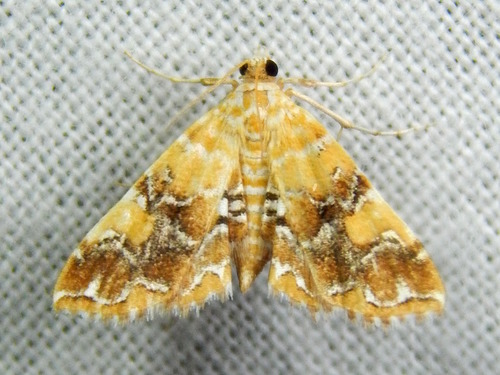
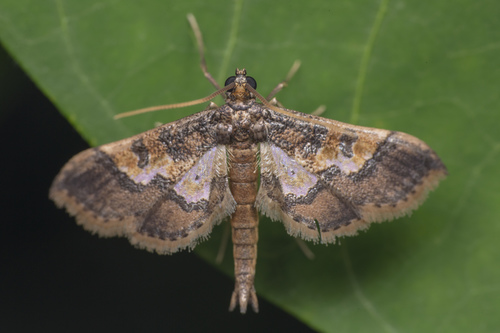
Anania coronata, commonly known as the elderberry pearl, elder pearl, or crowned phlyctaenia, is a moth species belonging to the family Crambidae. It was first described by Johann Siegfried Hufnagel in 1767. This species is native to the northern regions of the Palearctic realm. It was formerly thought to also occur in the Nearctic realm, but it is now recognized as part of a species complex. A. coronata is now confirmed to be restricted to the Palearctic realm, while the three closely related species A. plectilis, A. tertialis, and A. tennesseensis are found only in the Nearctic realm. Adult A. coronata closely resemble the species Anania stachydalis. The wingspan of this moth ranges from 23 to 26 mm. Its forewings are dark fuscous, sprinkled with yellowish-white scales. The first line marking is indistinct, and is preceded by a small whitish dot. The second line marking is dark fuscous, with a wavy whitish-yellow edge along its posterior side. The middle third of the second line forms a quadrangular projection that contains a pale whitish-yellow blotch. Below this projection, the line curves inward in a loop that encloses a whitish-yellow spot. The orbicular dot and transverse discal mark are darker than the surrounding wing, and are separated by a square whitish-yellow spot. Hindwings match the color and pattern of forewings, but anterior markings are not clearly visible, and posterior pale blotches are much larger. Full-grown larvae are whitish-green, with green dorsal and subdorsal lines, and yellowish coloration along body incisions. Most larvae have a black lateral spot on the third segment, and usually also on the fourth segment. Adult moths fly between May and August, with flight timing varying by location. Caterpillars of this species feed on elderberry, Calystegia sepium, sunflower, Ligustrum, Viburnum, and common lilac.