About Ananas comosus (L.) Merr.
Ananas comosus (L.) Merr., commonly known as pineapple, is a herbaceous perennial plant. It grows to an average height of 1 to 1.5 meters (3+1⁄2 to 5 feet), though it can occasionally grow taller. The plant has a short, stocky stem and tough, waxy leaves. When producing fruit, it typically forms up to 200 flowers, and some large-fruited cultivars can produce more than this. After flowering, the individual fruits from each flower merge together to form a multiple fruit.
After the first fruit develops, side shoots called 'suckers' by commercial growers grow from the leaf axils of the main stem. These suckers can be removed to grow new plants for propagation, or left on the original plant to produce additional fruits. For commercial cultivation, only suckers that grow around the base of the plant are grown on.
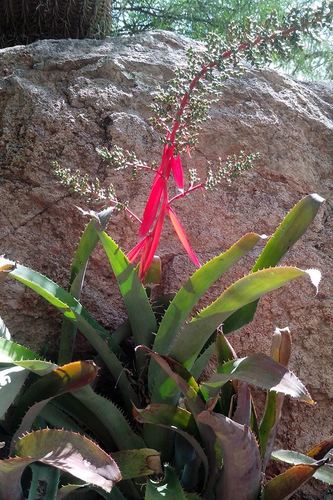
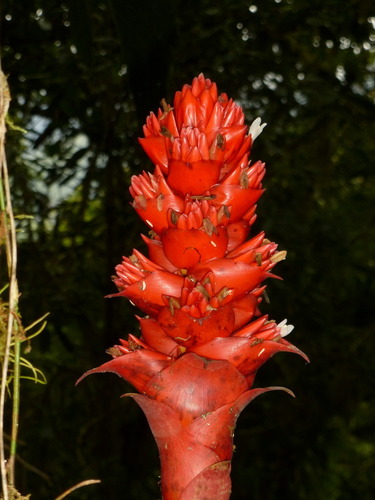
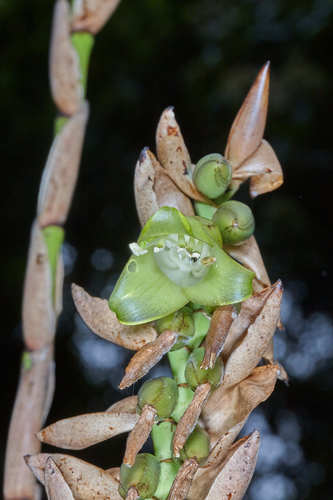
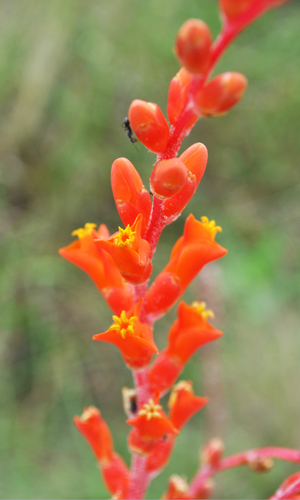
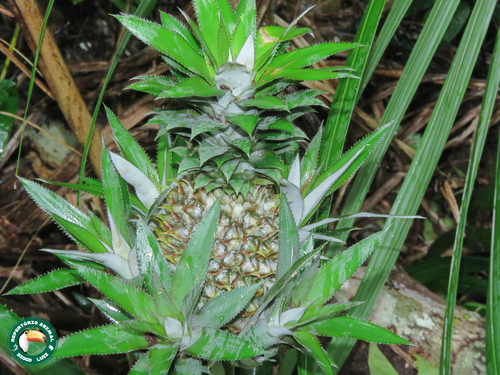
Pineapple has 30 or more narrow, fleshy, trough-shaped leaves that are 30 to 100 cm (1 to 3+1⁄2 ft) long, growing around a thick stem. Sharp spines run along the margins of the leaves. In the first year of growth, the central axis of the plant lengthens and thickens, producing numerous tightly packed, spirally arranged leaves. After 12 to 20 months, the stem develops into a spike-like inflorescence up to 15 cm (6 in) long. This inflorescence holds over 100 spirally arranged trimerous flowers, each with a bract growing beneath it.
In wild populations, pineapples are primarily pollinated by hummingbirds. Some wild pineapples are also foraged and pollinated at night by bats. Under cultivation, seed development reduces fruit quality, so pollination is done by hand, and seeds are only kept for plant breeding purposes. In Hawaii, where pineapples were industrially cultivated and canned throughout the 20th century, importing hummingbirds was prohibited.
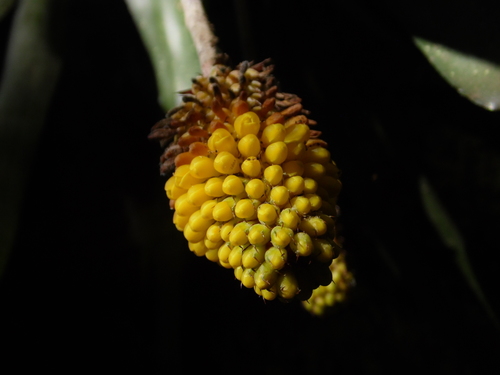
The ovaries of the flowers develop into berries, which merge into a large, compact multiple fruit. The fruit segments of a pineapple are usually arranged in two interlocking helices, most often with 8 spirals in one direction and 13 in the other, both of which are Fibonacci numbers. Pineapple uses CAM photosynthesis: it fixes carbon dioxide at night and stores it as malate acid, then releases the stored carbon dioxide during the day to support photosynthesis.
Wild pineapple originates from the Paraná–Paraguay River drainages between southern Brazil and Paraguay. Little is understood about how it was domesticated, but it spread as a crop across all of South America. Archaeological evidence of pineapple use dates back to 1200–800 BC (3200–2800 BP) in Peru, and 200 BC – 700 AD (2200–1300 BP) in Mexico, where the plant was cultivated by the Mayas and the Aztecs. By the late 1400s, cultivated pineapple was widely distributed and was a staple food for Native Americans.
Christopher Columbus was the first European to encounter the pineapple, in Guadeloupe on 4 November 1493. Portuguese traders took the fruit from Brazil and introduced it to India by 1550. The 'Red Spanish' cultivar was also introduced by the Spanish from Latin America to the Philippines, where it has been grown since at least the 17th century for its piña fibers, which are used to make textiles. Columbus brought the plant back to Spain and named it piña de Indes, meaning 'pine of the Indians'. The pineapple was documented in Peter Martyr's *Decades of the New World* (1516) and Antonio Pigafetta's *Relazione del primo viaggio intorno al mondo* (1524–1525), and the first known illustration of the plant appears in Oviedo's *Historia General de Las Indias* (1535).
In commercial pineapple farming, flowering can be triggered artificially. Early harvesting of the main fruit can encourage the growth of a second crop of smaller fruits. The leafy top of a harvested pineapple, once cleaned, can be planted in soil to grow a new whole plant. For commercial production, new plants are grown from slips and suckers.