About Anairetes parulus (Kittlitz, 1830)
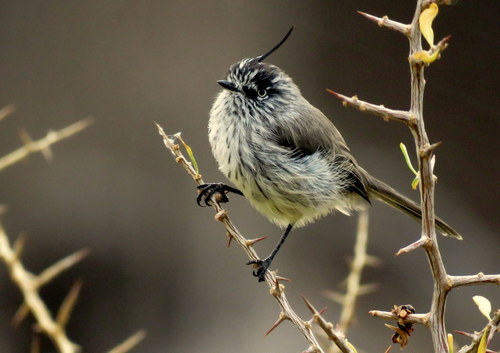
The tufted tit-tyrant, scientific name Anairetes parulus (Kittlitz, 1830), is a small bird. Adults average 9.5 to 11 centimeters (3.7 to 4.3 inches) in length and weigh approximately 6 grams (0.21 ounces). This species has a long, recurved crest that is usually conspicuous and often parted, creating the appearance of two separate crests. The crest's feathers are black and grow from the center of the bird's black crown; occasionally, a small patch of white is hidden under the crest. The head is mostly black, with a white supraloral and postocular stripe. The iris ranges from creamy white to pale yellow, and the bill is black. The back is a dull grayish brown, with the wings and tail being a duskier version of this color. The wings have two narrow white wingbars, and the outer tail feathers are white. The throat and breast are white, marked with dark gray to black streaks that become thinner further down the breast and along the sides. The belly is pale yellow, which fades as plumage wears, and the legs are black. Males and females look similar, though females are usually smaller and may have smaller crests. Juvenile tufted tit-tyrants have duller coloration and a shorter crest; their wingbars are buffy, and they lack the hidden white spot on the crown. There are three recognized subspecies, with little plumage variation between them. Compared to the nominate subspecies, Anairetes parulus aequatorialis has browner upperparts, broader and more extensive breast streaks, and broader, more distinct white wingbars. Anairetes parulus patagonicus is overall paler gray, especially on the crown, has broader and more distinct wingbars and breast streaks, and its underbelly is paler yellow to white. This species of flycatcher has a loud, high-pitched song. It produces a fast chuit-chuit-chuit-chuit-chuit-chidi-didi song, and sometimes gives slow series of single chuit notes. When foraging in pairs, tufted tit-tyrants use a perr-reet call to keep contact with each other, and the contact call has also been described as pluit-pluit. This bird is also known to give a long, weak trill. The tufted tit-tyrant has been recorded in Colombia, Ecuador, Peru, Bolivia, Argentina, and Chile. In the northern part of its range, it is mostly limited to the Andes mountains, while in the south its range expands to include the coast. It has also been recorded as a vagrant in the Falkland Islands. It is the most abundant and widely distributed of all tit-tyrant species. Its preferred habitat is upper montane forests and shrublands, but it is a habitat generalist that can also be found in elfin forest, the edges of cloud forests, Polylepis woodland, brushy forests with Chusquea bamboo, disturbed humid scrub, temperate forests, and dry thorn scrub. It recolonizes fire-stricken areas at a typical rate for páramo birds; it does not colonize recently burned areas unusually quickly, nor does it wait for the area to fully recover before moving back. It is most often found between 1,800 and 3,500 meters (5,900 and 11,500 ft) elevation, though it occurs at sea level in Chile and can be found as high as 4,200 meters (13,800 ft) in the Andes. This flycatcher typically raises two broods per year. Northern populations nest from January to June, while southern populations nest from August to January. During the breeding season, males are aggressive, and frequently chase potential rivals in undulating flights while making a whirring sound. Nests are built in shrubs or bamboo, often located next to a stream, clearing, or path, and are usually well hidden. Nests are small, compact open cups made from root fibers, lichens, grasses, and thistle down, with the interior lined with small feathers. Nests of this species are remarkably homogeneous, with only small variation in composition between individual nests. The clutch contains two to three creamy yellow eggs, which average 15.1 mm (0.59 in) by 11.8 mm (0.46 in) in size.