About Anairetes flavirostris P.L.Sclater & Salvin, 1876
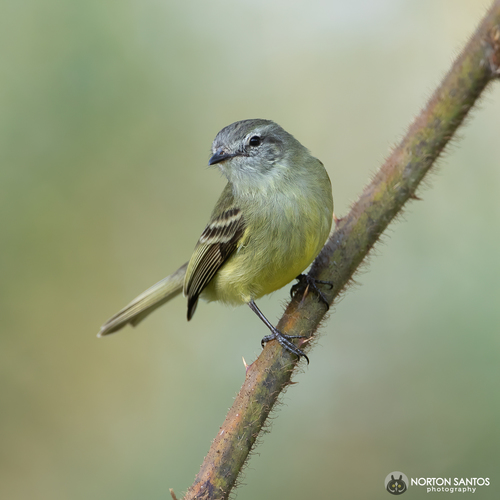
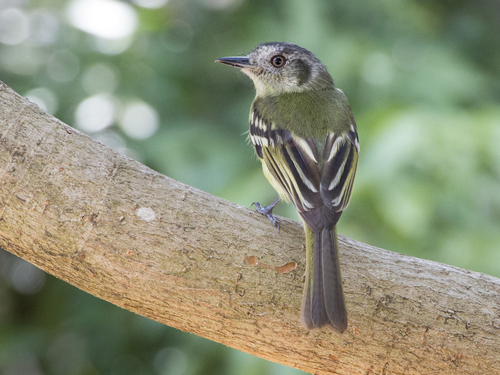
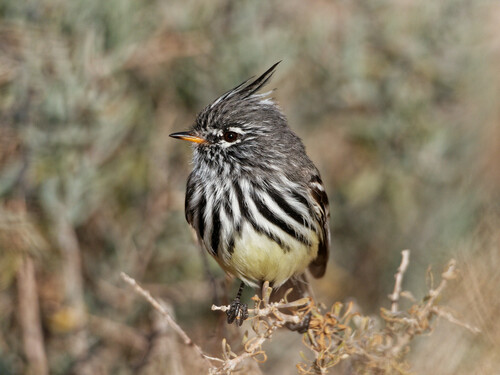
The yellow-billed tit-tyrant (Anairetes flavirostris) is 10 to 12 cm (3.9 to 4.7 in) long and weighs 6 to 7 g (0.21 to 0.25 oz). Males and females have identical plumage. Adults of the nominate subspecies A. f. flavirostris have a blackish split crest made of elongated feathers on the sides of the crown. Their forecrown is dusky gray with faint white streaks, the rest of the crown is white, their supercilium is white, and the remainder of their face is white with bold black streaks. Their upperparts are medium gray-brown with faint blackish streaks. Their wings are blackish, with buffy white tips and edges on the inner flight feathers. Their wing coverts have cinnamon-buff tips that form two distinct bars on the closed wing. Their tail is dusky brownish, with paler outer webs on the outermost pair of feathers and paler tips on all other tail feathers. Their throat, breast, and upper belly are white with bold black streaks, while their flanks, lower belly, and undertail coverts are unmarked yellowish. Juveniles have a shorter crest than adults, and are duller, more buffy, and less strongly streaked. Subspecies A. f. huancabambae has more white in the crown than the nominate subspecies; its back is dark brown with strong blackish streaks, and its tail feathers have white edges and tips, compared to the nominate's pale brownish coloration in those areas. Subspecies A. f. arequipae's tail feathers have dull brownish edges and tips that are only slightly paler than the rest of the tail, and its belly is less yellowish than the nominate's belly. Subspecies A. f. cuzcoensis is the largest subspecies, and has the least amount of white on its crown. Its back is darker brown and more heavily streaked than the nominate's, and its breast has wider and darker streaks than the nominate's. Both sexes of all subspecies have a dark brown iris, a black maxilla, a yellow mandible with a black outer half or black tip, and slate-gray to black legs and feet. The nominate subspecies of the yellow-billed tit-tyrant is the southernmost of the four recognized subspecies. It occurs in the Andes of Bolivia and western Argentina, ranging as far south as Chubut Province and east to Buenos Aires and Entre Ríos provinces. Subspecies A. f. huancabambae occurs in the Andes of northern Peru, from Piura and Cajamarca departments south to Ancash and Huánuco. Subspecies A. f. arequipae occurs on the western slope of the Andes, from Peru's Lima Department south into the Arica and Tarapacá regions of northwestern Chile. Subspecies A. f. cuzcoensis is currently only recorded from Peru's Cuzco Department, though its range may extend north into Junín Department. Additionally, the South American Classification Committee of the American Ornithological Society documents the nominate subspecies as a vagrant in Uruguay. The yellow-billed tit-tyrant lives in a range of dryish semi-open to open landscapes. These include dry montane and desert scrublands, thorn scrub, semi-arid brush, and somewhat humid woodlands dominated by Polylepis and Gynoxys trees and shrubs. It is found mostly at elevations between 1,900 and 4,100 m (6,200 and 13,500 ft), but west of the Andes it occurs locally almost at sea level, especially in coastal lomas, also known as fog oases.