About Anaea pithyusa (Felder, 1869)
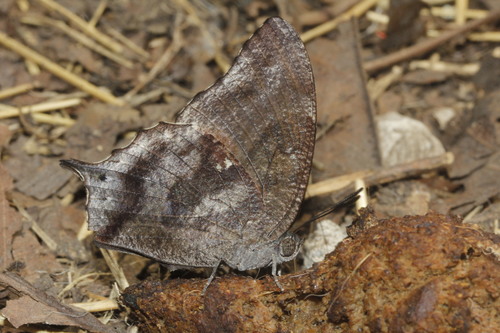
Memphis pithyusa (also known by the scientific name Anaea pithyusa (Felder, 1869)) is a butterfly species with a wingspan ranging from 57 mm to 76 mm. Its forewings have a concave outer edge, and its hindwings have a tail. The upper wing surface ranges from dark blue to brown; the basal area is lighter, colored blue or blue-green, and has a submarginal line of light dots. The underside of the wings is light brown and mimics a dead leaf. This species is the smallest form in its group. It differs from similar species primarily in wing shape: both the distal margin and proximal margin of the forewings are much less deeply sinuous, so the inner angle does not project as far, and the projection of the forewing apex is also reduced. According to Druce, the male (corrected from a repeated reference to female) is much larger than the female, has a bluer base to the wings, and has larger, mostly white spots on the forewings. The species is common across many areas. It is distributed in South Texas, Mexico, Costa Rica, Colombia, Bolivia, and Guyana, and lives in various types of forest.