About Anacardium occidentale L.
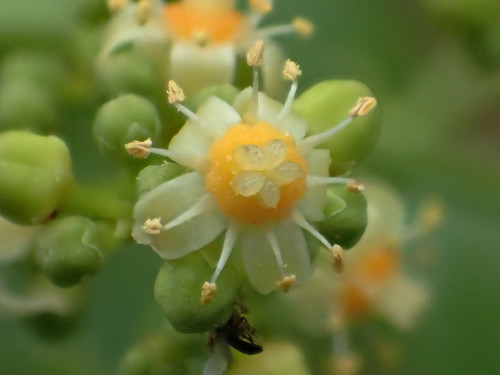
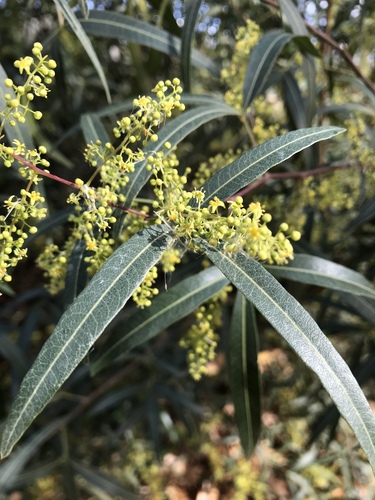
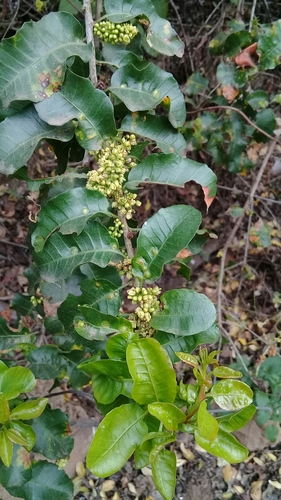
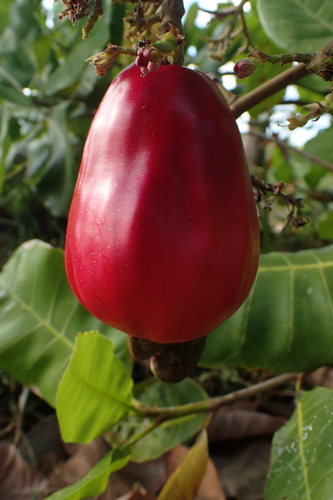
Anacardium occidentale L., commonly known as the cashew tree, is a large evergreen tree that reaches 14 metres (46 feet) in height, with a short, often irregularly shaped trunk. Its leaves are spirally arranged, leathery in texture, and shaped from elliptic to obovate; they measure 4–22 centimetres (1+1⁄2–8+3⁄4 inches) long and 2–15 cm (3⁄4–6 in) broad, with smooth margins. Flowers form in panicles or corymbs up to 26 cm (10 in) long. Individual flowers are small, starting pale green before turning reddish, with five slender, pointed petals 7–15 millimeters (1⁄4–5⁄8 in) long. The largest known cashew tree in the world grows in Parnamirim, Brazil, and covers an area of approximately 7,500 m² (81,000 ft²). The edible structure commonly referred to as a cashew fruit is actually an accessory fruit (also called a pseudocarp or false fruit), specifically a hypocarpium that develops from the pedicel and receptacle of the cashew flower. This structure, called the cashew apple (known as marañón in Central America), ripens to a yellow or red color and grows 5–11 cm (2–4+1⁄4 in) long. The true fruit of the cashew tree is a kidney-shaped or boxing glove-shaped drupe that grows at the end of the cashew apple. The drupe develops first on the tree, after which the pedicel expands to form the cashew apple. The drupe contains a single seed encased in a hard shell, and this seed is what is commonly considered a cashew nut in culinary contexts. The seed is surrounded by a double shell that holds an allergenic phenolic resin called anacardic acid. This compound is a potent skin irritant chemically related to the well-known toxic allergenic oil urushiol, which is found in the related poison ivy and lacquer tree. This species is native to tropical South America. Portuguese explorers distributed it across the world starting in the 1500s; Portuguese colonists in Brazil began exporting cashew nuts as early as the 1550s. The Portuguese brought cashew trees to Goa (then part of Portuguese India) between 1560 and 1565, and from there the species spread across Southeast Asia and eventually to Africa. While some people are allergic to cashews, they are a less common allergen than many other tree nuts or peanuts. Up to 6% of children and 3% of adults may experience allergic reactions after consuming cashews, which range from mild discomfort to life-threatening anaphylaxis. These allergic reactions are triggered by proteins in the cashew, and cooking typically does not remove or alter these proteins. Allergic reactions can also happen from hidden cashew ingredients or accidental traces of cashew introduced during food processing, handling, or manufacturing. The shell of the cashew seed contains oil compounds that can cause contact dermatitis similar to poison ivy, which is primarily caused by phenolic lipids anacardic acid and cardanol. Because of this skin irritation risk, cashews are almost never sold in their shells to consumers. Cardanol can be extracted inexpensively from waste cashew shells, and it is currently under research for potential applications in nanomaterials and biotechnology. Cashew trees are cultivated in tropical regions between 25°N and 25°S latitude. They are well-adapted to hot lowland areas with a distinct dry season, the same conditions where mango and tamarind trees also grow well. Traditional tall cashew trees grow up to 14 m (46 ft) tall, take three years after planting to start producing fruit, and require eight years to produce economically viable harvests. Newer dwarf cashew tree cultivars reach only 6 m (20 ft) in height, begin producing one year after planting, and produce economic yields after three years. Traditional trees yield around 0.25 tonnes of cashew nuts per hectare, while dwarf cultivars yield over one tonne per hectare. Grafting and other modern tree management techniques improve and maintain consistent cashew nut yields in commercial orchards. Beyond the culinary use of its nut and cashew apple, the cashew tree has several other uses. In Cambodia, the bark produces a yellow dye, the timber is used for boat-building and house boards, and the wood makes high-quality charcoal. Cashew shells yield a black oil that is used as a preservative and waterproofing agent in varnishes and cement, and also serves as a lubricant or timber seal. Shell derivatives are also used in paints. Cashew timber is used to make furniture, boats, packing crates, and charcoal. The tree's juice turns black when exposed to air, making it useful as an indelible ink.