About Anacamptis pyramidalis (L.) Rich.
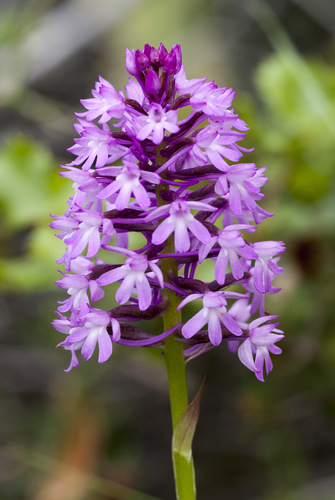
This hardy orchid, Anacamptis pyramidalis, reaches an average height of 10–25 centimetres (3.9–9.8 inches), with a maximum height of 60 centimetres (24 inches). It has an erect, unbranched stem. Its basal leaves are linear-lanceolate with parallel venation, growing up to 25 centimetres (9.8 inches) long, while its cauline leaves are shorter and barely visible along the stem. This orchid produces hermaphroditic flowers arranged in a distinctive compact pyramidal shape, which gives it its common name. Flower color ranges from pink to purple, and is rarely white; the flower scent is described as "foxy". Flowers have six tepals: three small sepals and three petals. Two small petals sit on the sides, while the third lower petal (called the labellum) is large and trilobate. A tubular spur around 1.5 centimetres (0.59 inches) long grows at the back of the flower, and the labellum has two small lateral flaps. Its flowering season runs from April to July.
Anacamptis pyramidalis grows best in sunny locations on a range of soil types, including loamy, clay, and even very alkaline soil. It can be found in meadows, grassland, sand dunes, maquis, and dry, well-exposed slopes, at altitudes from 0 to 1,600 or more metres above sea level (approximately 0–5,250 ft). In the United Kingdom, it successfully colonizes disturbed soil, and can grow in a wide variety of locations including road verges, reservoirs, quarries, and airfields.
This orchid is native to southwestern Eurasia, ranging from western Europe through the Mediterranean region eastward to Iran. In Germany, it is rare, and was named Orchid of the Year in 1990 to raise public awareness of the species. It is especially common on the Isle of Wight in southern England, and was designated the county plant in 2008. On the Isle of Wight, it prefers to grow in chalky or sandstone-rich soil, so it is easily found on the Downland and cliffs to the west and south of the island.
The flowers of Anacamptis pyramidalis are pollinated by butterflies and moths. Its flower structure is well adapted to the proboscis of Lepidoptera, especially species in the genera Euphydryas, Melanargia, Melitaea, Pieris, and Zygaena. The mechanism by which its pairs of pollinia attach to an insect's proboscis was discovered by Charles Darwin, who described it in his book *Fertilisation of Orchids*. Research suggests Anacamptis pyramidalis forms mycorrhizal relationships with species of Rhizoctonia, Fusarium, and Papulaspora.
Dried, ground tubers from various Orchis and Anacamptis species, including this one, are processed to make a fine white powder called salep. Salep is a nutritious, sweet, starch-like substance. It is used in drinks, cereals, bread making, and in ice cream in Turkey. Historically, it was also used medicinally in special diets for children and people recovering from illness.