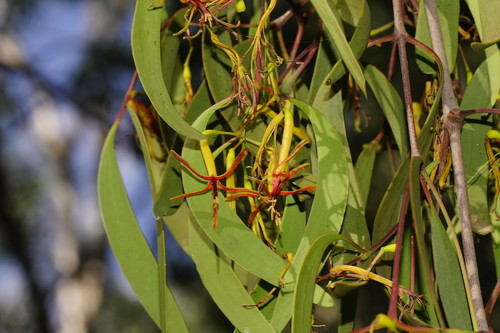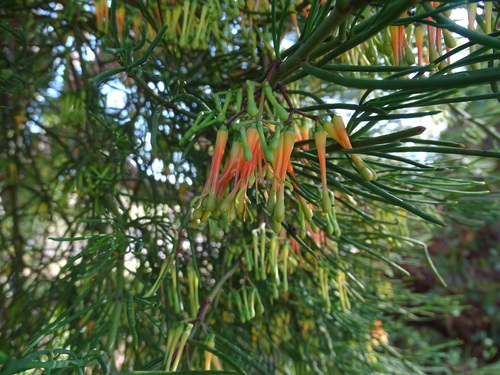
About Amyema preissii (Miq.) Tiegh.
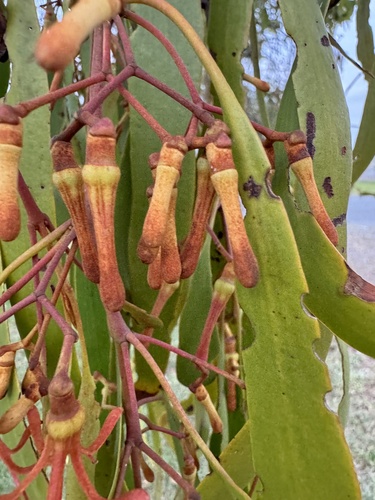
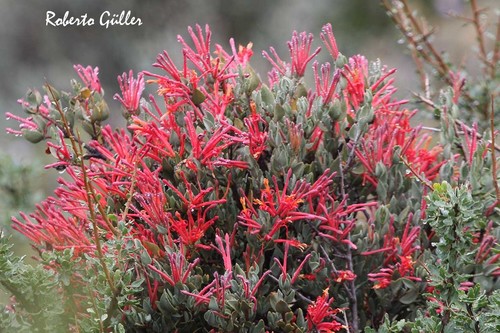
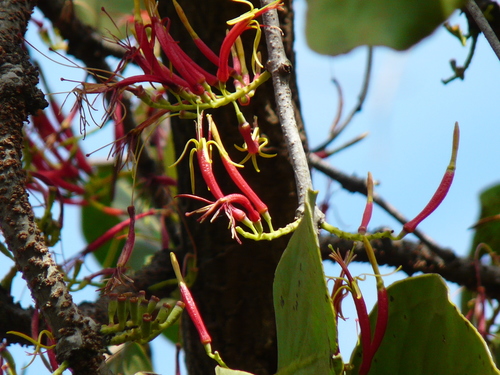
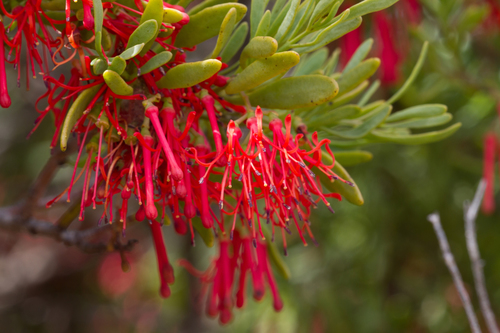
Amyema preissii is the only mistletoe with slender, needle-shaped leaves, and all-red flowers arranged in groups of three that lack a velvety covering. This distinctive species has feathery foliage made up of soft, needle-like leaves that have pointed but not sharp tips. Its foliage can be open and loosely branched, or dense and very closely branched, and individual plants often show both branching variants. This mistletoe produces abundant orange-red flowers that have smooth bases and buds, and are borne in groups of three. A closed, downward-hanging flower is made of five tepals, which are fused into a long tube with a bulbous end. The fruit is a dark pink, translucent, globular berry 6-10mm long. A shiny cuticle covers the rind, which surrounds a mucilaginous viscid layer that takes up most of the fruit's volume. At the center of the fruit is the seed, which has a well-developed endosperm and a green embryo that projects toward the distal end of the fruit. Part of the hypocotyl protrudes from the seed, and this may elongate up to 10mm during germination. The apex is swollen even at this early stage, and the primary haustorium develops inside its tip. It can be distinguished from the otherwise similar samphire mistletoe by its longer leaves, which are at least 2cm long. It differs from the harrow-leaved mistletoe (Amyema cambagei, also called needle-leaved mistletoe that grows on Casuarina and Allocasuarina luehmannii) and Amyema gibberula mistletoes by its smooth flower buds arranged in groups of three, and its translucent fruit. The family Loranthaceae is native to Australia, with 75 currently recognized species of showy mistletoe. As a member of the Loranthaceae family, Amyema preissii is among the most widespread of Australian mistletoes. It occurs in all Australian mainland states, and its preferred habitat is open forest, woodland, and semi-arid woodland, particularly habitat types dominated by Acacia species. Amyema preissii is highly host specific, and shows a preference for Acacia victoriae as a functional host, especially in Western Australia. In Australia, loranthaceous mistletoes depend on birds for pollination and seed dispersal, and provide important nectar and fruit resources to a large number of nectarivore and frugivore birds. Amyema preissii is dispersed by at least two species of frugivorous birds, especially the mistletoebird. Amyema preissii seedlings either establish successfully or die within three months. Surviving seedlings normally grow rapidly and flower 18 months later, producing fruit at three years old. Under ideal conditions, however, seedlings can develop into a mature, fruiting plant in just nine months. After maturing, plants produce fruit annually until they die. The maximum lifespan of Amyema preissii is around 17 years. Mistletoes do not form a seed bank, and their seeds must be dispersed onto host branches with specific characteristics to have a chance of survival. To help seeds disperse onto host branches, mistletoe seeds are incredibly sticky, as they are covered in a glue-like substance called viscin that helps them adhere to any surface they land on.