About Amphipyra tragopoginis (Clerck, 1759)
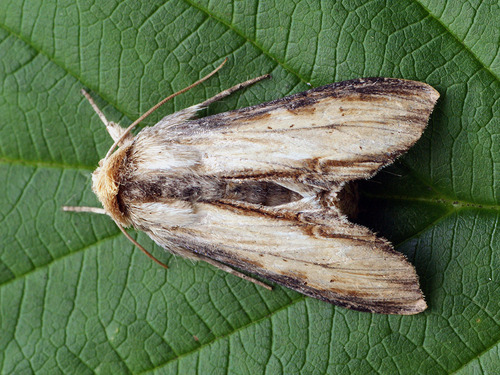
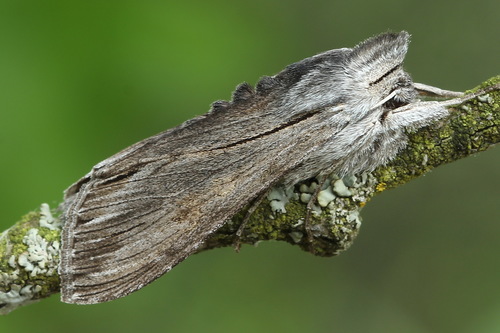
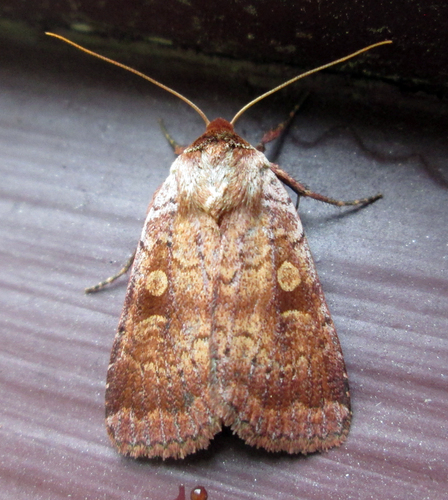
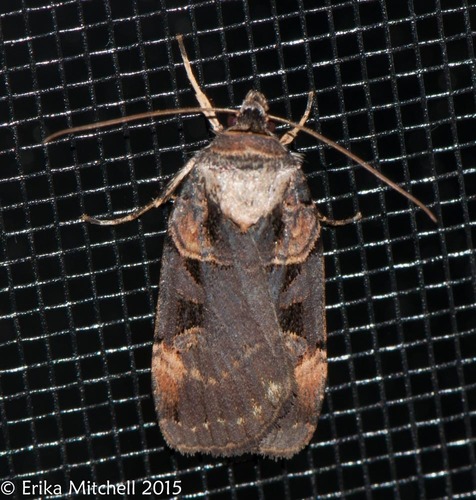
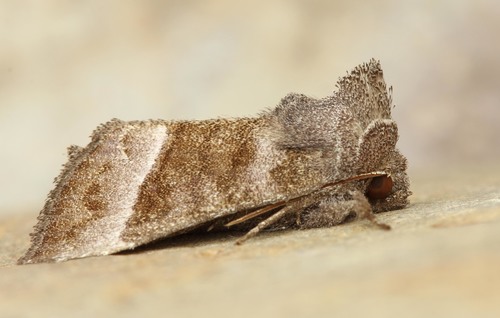
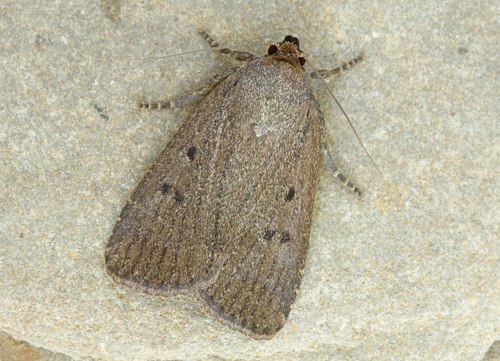
Amphipyra tragopoginis (Clerck, 1759), commonly called the mouse moth, is a rather drab but distinctive moth species with a wingspan of 32–40 mm. Its forewing is dull brown, dusted with paler scales, and ranges in shade from pale to blackish brown. Only the submarginal line is visible, marked by a paler tinge that is preceded by a darker shade. The orbicular stigma is a blackish dot, while the reniform stigma is represented by two blackish dots, one positioned above the other at the end of the cell. The hindwing is rufous fuscous, and paler towards its base. The subspecies A. t. turcomana (Staudinger, 1888), also known as turcomana Stgr., is pale ashy grey with no trace of a submarginal line. Its stigmata are very faint and more or less obsolete, and its hindwing is also much paler, dull whitish that becomes grey towards the termen. This central Asiatic form is probably a good species, and its forewing has a more decidedly prominent apex. Blacker forms of the species are separated as ab. nigrescens Spul. The moth's forewings are generally uniform dark brown with three blackish spots arranged in a triangle, and the hindwings are buffish, darker towards the margins. The green larva has yellowish or white dorsal and subdorsal lines, and feeds on a wide variety of plants. Recorded food plants for the species include monkshood, chervil, dogbane, columbine, wormwood, bellflower, eastern redbud, hawthorn, fireweed, fennel, strawberry, bedstraw, geranium, Scots lovage, toadflax, cow-wheat, monkeyflower, tobacco, parsley, plantain, poplar, Prunus, oak, redcurrant, rose, cloudberry, sorrel, willow, salad burnet, nettle, indica, and grape. This species overwinters in the egg stage. Its common name comes from its habit of scuttling away on foot when disturbed instead of flying. Despite this behavior, it can fly strongly, and is attracted to light, sugar, and nectar-rich flowers. In the British Isles, adults are active from July to September. Its natural distribution covers Europe except for the extreme north, and it does not occur in southern Spain, Sicily, or the Balkans. It is also found in Armenia, Asia Minor, Syria, Iran, Western Siberia, and Kashmir, extending from Kashmir into Punjab. It has recently been introduced to Canada and North America.