About Amphiagrion abbreviatum (Selys, 1876)
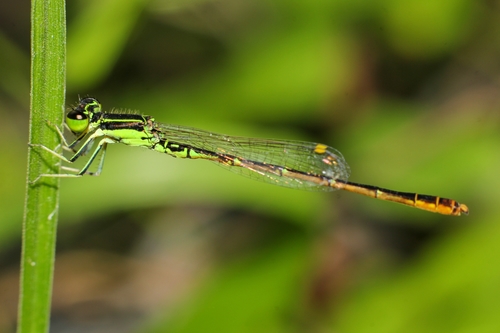
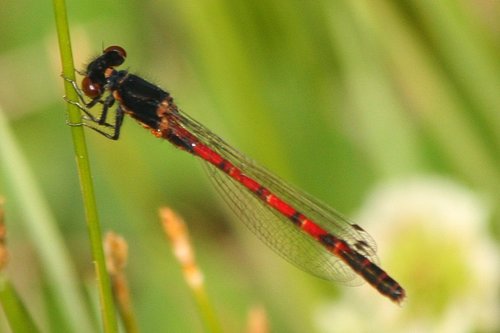
Amphiagrion abbreviatum, commonly known as the western red damsel, is a species of narrow-winged damselfly belonging to the family Coenagrionidae. This species is found in Central America and North America. The IUCN has assessed the conservation status of Amphiagrion abbreviatum as "LC" (least concern), meaning there is no immediate threat to the species' survival. Its population is currently stable, and its IUCN conservation status was last reviewed in 2017.
The western red damsel is primarily distributed across western North America, with confirmed records from four Canadian provinces, 23 U.S. states, and one Mexican state. Its range stretches from British Columbia and the northern prairies south to the southwestern United States and Baja California.
For a long time, Amphiagrion abbreviatum was classified as a lentic (still water) species. It is typically found in spring-fed marshes and seepage areas in arid regions, as well as along the vegetated edges of ponds, lakes, and slow-moving streams. These calm, stable bodies of water offer ideal conditions for larval development among submerged vegetation, and allow adults to perch and lay eggs without being swept away by moving water. However, recent fieldwork conducted in southern Alberta has discovered an unexpected occurrence: thriving, reproducing populations of A. abbreviatum living in flowing riverine systems, including the North Milk River and Pincher Creek. At these locations, the damselflies were observed perching, mating, and laying eggs on gravel bars, emergent vegetation, and riparian grasses, all in conditions of slow but consistent current. This documented reproductive activity in lotic (flowing water) environments indicates that A. abbreviatum has the behavioral and possibly morphological traits needed to utilize these habitats. Unlike most damselfly species, which specialize in either lentic or lotic systems, A. abbreviatum occupies both. This unexpected habitat versatility challenges existing assumptions about ecological specialization, and marks the species as a rare example of habitat plasticity among Odonata.