About Ammospiza maritima (A.Wilson, 1811)
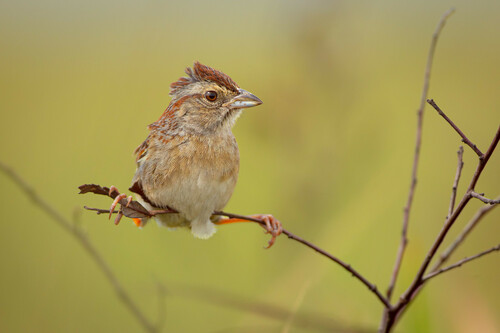
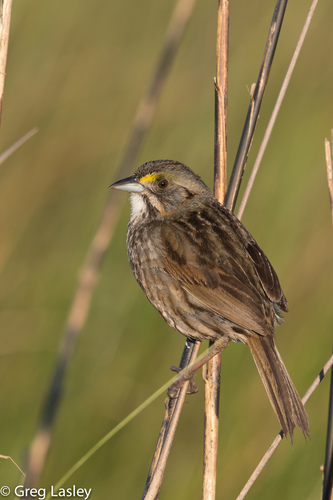
Adults of this species have brownish upperparts, with gray coloration on the crown and nape. Their breast is grayish-buff with dark streaks, they have a dark face with gray cheeks, a white throat, and a short, pointed tail. A small yellow streak is visible just above the eye. The maximum typical lifespan of a seaside sparrow is 8 to 9 years. The oldest recorded seaside sparrow was a male that was at least 10 years old when it was recaptured and re-released during banding operations in South Carolina. Their breeding habitat is salt marshes located on the Atlantic and Gulf coasts of the United States, ranging from southern New Hampshire to southern Texas. The nest is an open cup, typically built in the salt marsh on tidal reeds and spartina grasses. Females lay between two and five eggs. Northern populations most often migrate farther south along the eastern coast of the United States. These birds forage on the ground or within marsh vegetation, and sometimes probe in mud. They mainly feed on insects, marine invertebrates, and seeds. Their feeding areas are often located some distance away from the areas they select for nesting. Their song is a raspy buzz that closely resembles the call of a distant red-winged blackbird. One of the many subspecies of this bird, the dusky seaside sparrow (A. m. nigrescens), has recently become extinct, while the Cape Sable subspecies A. m. mirabilis is classified as endangered. Scott's seaside sparrow (A. m. peninsulae) occurs in a restricted range and its validity as a subspecies is uncertain. The small isolated population found from near Corpus Christi, Texas, south to the Rio Grande, along with the sennetti subspecies, may also be at risk of endangerment; these were formerly considered to be a separate species.