About Ammospiza leconteii (Audubon, 1844)
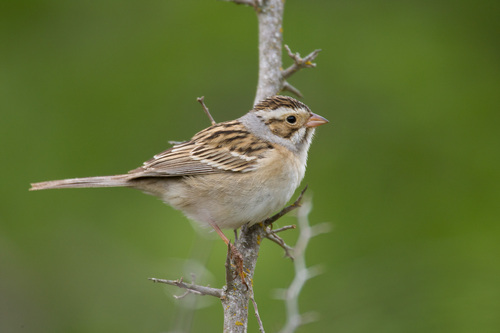
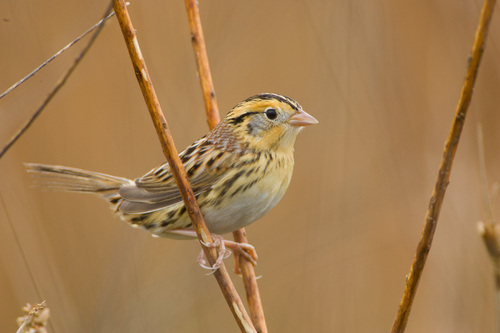
LeConte's sparrow (Ammospiza leconteii (Audubon, 1844)) is a small sparrow, characterized by a relatively large head, short grey bill, and short pointed tail. It has a buffy yellow-orange face with grey cheeks, and a dark brown crown with a white central stripe. The nape of the neck is lilac grey with chestnut streaks, and the back is streaked with brown and beige. Its belly is off-white, while the breast and sides are buffy orange-yellow with dark brown streaks. The feet and legs are brownish-pink. LeConte's sparrow breeds in scattered parts of Canada, including northeastern British Columbia, all of Alberta, Saskatchewan, and southern Manitoba, as well as central Ontario extending into Quebec. Its breeding range reaches as far south as northern Michigan, Montana, and Minnesota. It winters in the southeastern United States, reaching as far west as central Texas and as far north as central Illinois and Missouri. This species prefers moist open grassy areas with enough vegetation cover for shelter. Documented habitats used by the sparrow include meadows, fields, crop stubble, shallow marsh edges, and prairie; it occasionally occurs in fens and lake shores within the boreal forest. Research has found that vegetation has a greater effect on this species' abundance than other factors such as climate or patch size. Winter et al. (2005) note that the species reaches its highest population densities in areas with moderate amounts of bare ground. The greatest current threat to LeConte's sparrow is agriculture and drainage of its preferred habitats. Mating activity can begin as early as late April, and peaks in mid-May. Males sing from within dense grass cover, while perched on tall grass, or in flight. Clutch sizes range from two to six eggs, with four being the most common. Only the female incubates the eggs, though both parents help feed the hatchlings. Incubation lasts an average of 11 to 13 days. Newly hatched chicks are altricial, with dull brown downy patches. Breeding pairs produce one or two broods per year. Because of this bird's secretive behavior, little is known about the length of time between hatching and fledging.