About Ammospiza caudacuta (J.F.Gmelin, 1788)
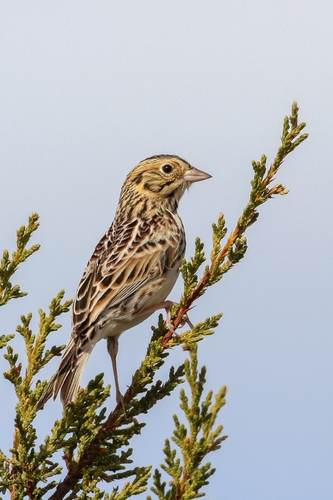
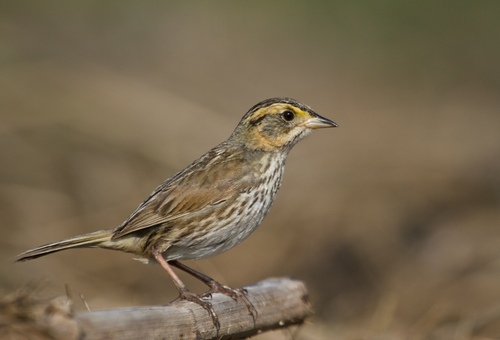
The saltmarsh sparrow, scientifically named Ammospiza caudacuta (J.F.Gmelin, 1788), measures 11–14 cm (4.3–5.5 in) in length, has a wingspan of 17.8–21 cm (7.0–8.3 in), and weighs 14–23.1 g (0.49–0.81 oz). Adult saltmarsh sparrows have brownish upperparts, a gray nape, a white throat and belly, and a pale orange breast and sides marked with brown streaking. Their face is orange with gray cheeks, a gray median crown stripe, brown lateral crown stripes, and a brown eyeline. Their tail feathers are short and sharply pointed. The subspecies A. c. diversa has more contrasting back striping and a darker crown than the nominate subspecies A. c. caudacuta. Only male saltmarsh sparrows sing. Their song is a complex series of raspy, barely audible buzzes, trills, and gurgles. This song can be distinguished from the song of the Nelson's sparrow, which is a louder hissing buzz followed by a buzzy chip. The high-pitched contact calls of saltmarsh sparrows and Nelson's sparrows are indistinguishable. It can be difficult to tell saltmarsh sparrows apart from closely related sparrows such as Nelson's sparrow (Ammospiza nelsoni). Inland Nelson's sparrow subspecies can be differentiated by their fainter streaking and brighter orange breast and sides, while coastal Nelson's sparrow subspecies have paler, less contrasting plumage. Saltmarsh sparrows also have a slightly longer beak than Nelson's sparrows. The saltmarsh sparrow lives only in tidal salt marshes along the Atlantic coast of the United States. It breeds along the northern Atlantic coast from Maine to Chesapeake Bay, and winters along the southern Atlantic coast from North Carolina to Florida. It prefers high marsh habitat, which is dominated by saltmeadow cordgrass (Sporobolus pumilus) and saltmarsh rush (Juncus gerardii) and floods less frequently than low marsh habitat.