About Ammodramus savannarum (J.F.Gmelin, 1789)
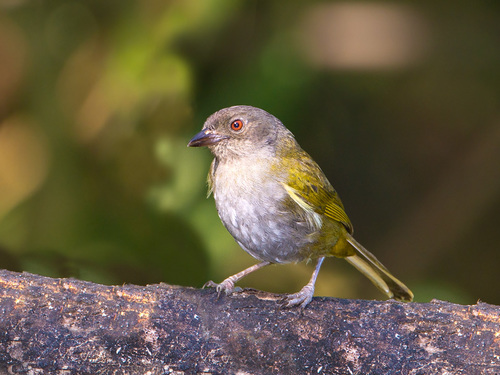
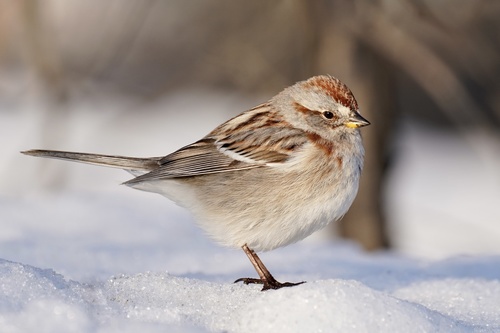
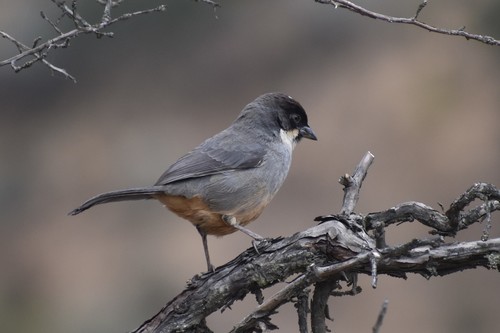
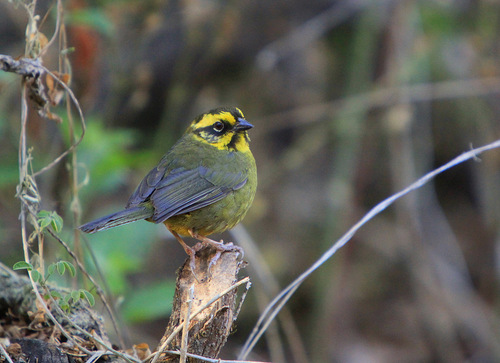
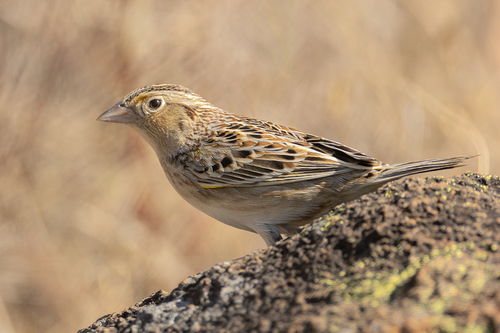
This species, commonly known as the grasshopper sparrow, has the scientific name Ammodramus savannarum (J.F.Gmelin, 1789). These small sparrows measure 10–14 cm (3.9–5.5 in) in total length, have a wingspan of approximately 17.5 cm (6.9 in), and weigh between 13.8 and 28.4 g (0.49 to 1.00 oz), with an average weight of 17 g (0.60 oz). Adult grasshopper sparrows have streaked upper parts in shades of brown, grey, black, and white, a light brown breast, a white belly, and a short brown tail. Their face is light brown, marked with a white eye ring and a dark brown crown that has a narrow central light stripe. Adults have bright yellow feathers at the crook of their underwing, and a yellow-to-amber colored patch above their lores. Male and female grasshopper sparrows cannot be told apart by their plumage, and young birds molt into adult plumage within a few months after fledging. Their breeding habitat consists of open fields and prairie grasslands across southern Canada, the United States, Mexico, Central America, and the Caribbean. A small, endangered population exists in the Andes of Colombia, and may have formerly existed in Ecuador. In the central United States, these birds quickly locate newly available habitat, and can be drawn to sites by playing recordings of the same species' song. On the landscape, breeding territories can be distributed in clumps, with multiple birds defending territories close to one another, while large areas of apparently suitable unused habitat lie between these clumps. The causes of this clumped distribution are not understood; aggregation is not linked to group defense against predators or brood parasites, cooperative care of young, extra-pair matings, or kin selection. Suitability of habitat is strongly affected by plant structure and precipitation levels from previous seasons. Grasshopper sparrows avoid woody vegetation. In the wetter portions of their range, they prefer fields that are burned every 2–3 years, which reduces encroachment by trees and shrubs, and seek out areas that are moderately grazed by cattle or bison. Most of the grasshopper sparrow's former breeding range in North America has been converted to intensive agriculture or has become encroached by shrubs and trees. The species is also losing wintering habitat, particularly in the Chihuahuan grasslands, from the same types of impacts: conversion to agriculture and woody encroachment. Because grasshopper sparrows need areas of dense dead grass for nesting, sparse vegetation for foraging, and little to no woody plants, they are negatively affected by management practices including high-intensity grazing paired with annual burning, fire suppression that leads to woody encroachment, and haying that occurs during the breeding season which can destroy nests. Ideal grazing intensities and fire frequencies vary across the species' range based on local climate, but in the Southern Great Plains, areas with moderate grazing by cattle or bison, prescribed burning every 2–3 years, and removal of woody plants typically support the highest densities of grasshopper sparrows.