About Ammannia baccifera L.
Ammannia baccifera L., commonly called monarch redstem or blistering ammannia, is a species in the plant family Lythraceae. It is widespread across tropical regions of Asia, the Americas, and Africa, and has become naturalized in Spain. This annual herb grows in marshes, swamps, rice fields, and watercourses at low elevations. While it is considered endangered in Israel, the International Union for Conservation of Nature (IUCN) lists its global conservation status as Least Concern due to its widespread distribution and common occurrence across most of its range.
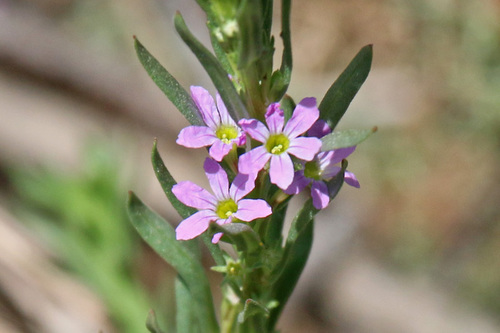
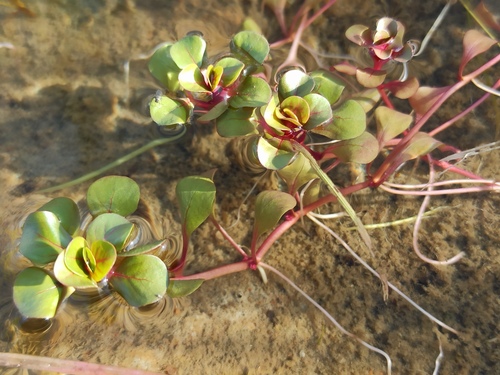
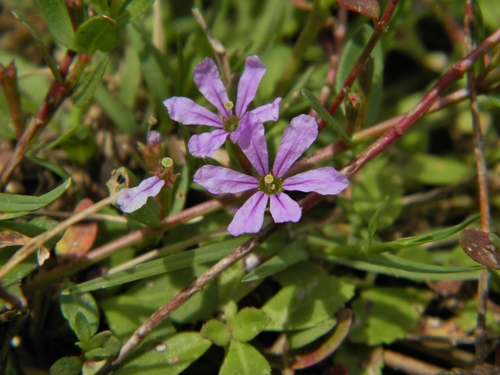
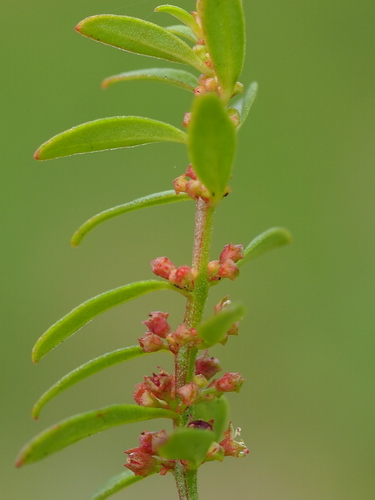
Ammannia baccifera is an erect, branched, smooth, slender, more or less purplish annual herb that reaches 10 to 50 centimeters in height. Its stems are somewhat four-angled. Its leaves are oblong, oblanceolate, or narrowly elliptic; leaves on the main stems grow to around 3.5 centimeters long, while leaves on branches are much smaller and more numerous, measuring 1 to 1.5 centimeters long. All leaves have narrowed bases and pointed or somewhat rounded tips. The plant produces small flowers, around 1.2 millimeters long, that are greenish or purplish and borne in dense axillary clusters. Its seed capsules are nearly spherical and depressed, measuring around 1.2 millimeters in diameter, are purple in color, and split irregularly around the upper half. The seeds are black, as documented by Nadkarni in 1982.
This bitter herb acts as an appetizer and stomachic, and is used to treat biliousness, which includes symptoms of poor digestion, stomach pain, constipation, and excessive flatulence. The leaves help remove phlegm from the lungs and trachea. According to Ayurvedic practitioners, the plant's herbal extract is an effective remedy for tuberculosis and typhoid fever. Plant juice mixed with ginger extract is used to treat fevers. Tribal groups consider the herb an effective treatment for all blood diseases. In India, leaves of the plant are used to reduce sexual libido in animals. The acrid leaves are used in folk medicine to treat rheumatic pain, and are used as a laxative, a rubefacient, and an external treatment for ringworm, as recorded by Kirtikar in 1972.
Scientific studies have confirmed that the plant has hypothermic, hypertensive, antiurolithiasis, antibacterial, and central nervous system depressant activities, as reported by Dhar et al. in 1973, Bharathi and Srinivasan in 1994, and Al-Sharma and Mitschar in 1979. More recent studies have found that ethanol extracts of Ammannia baccifera have antisteroidogenic, antioxidant, and hepatoprotective activities, as documented by Ramaiyan Danapal et al. in 2005, and Lavanya et al. in 2009. Chemical compounds identified in the herb include betulinic acid, daucosterol, ellagic acid, n-hentricontane, lupeol, quercetin, and triacontane-1,30-diol.