About Amelanchier ovalis Medik.
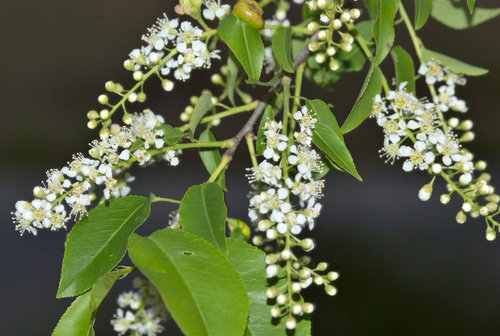
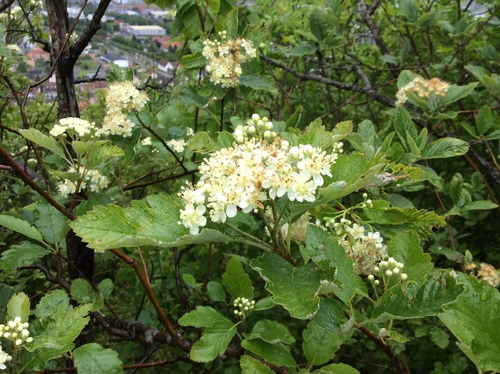
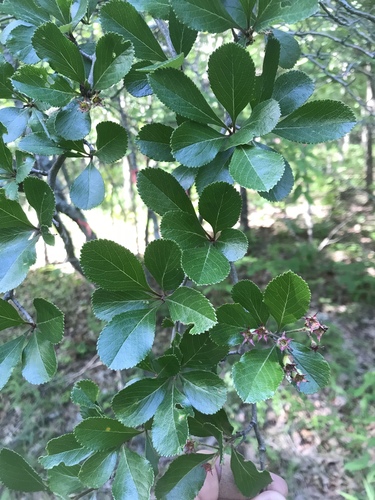
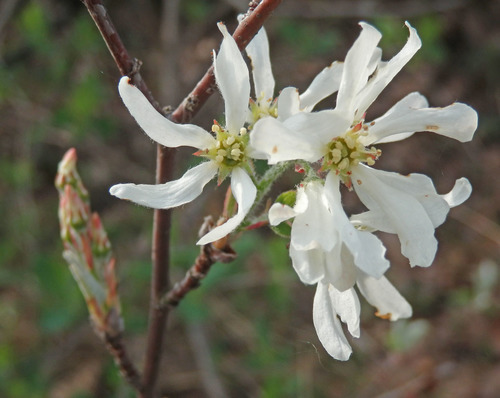
The genus Amelanchier contains 25 species found across the northern hemisphere; Amelanchier ovalis Medik. is the only Amelanchier species that naturally occurs in Europe. This species shows wide morphological variation in its flowers and leaves, and is divided into two subspecies that can be distinguished by their chromosome counts: the diploid (2n=34) A. ovalis subsp. ovalis, and the tetraploid (2n = 68) A. ovalis subsp. embergeri. Amelanchier ovalis is a thornless, deciduous summer-green shrub with an irregular spreading growth habit. It typically reaches 3 m (9.8 ft) in height, and rarely grows as tall as 5 m (16 ft). When young, its branches are slender and held tightly erect, and they extend outward as the plant ages. Young shoots are thin and covered in white hairs, while older shoots are olive or reddish-brown. Felted hairs on the buds are a characteristic trait of this species. Its leaves are round or egg-shaped, growing 2 to 5 cm long. The upper surface of mature leaves is hairless; the underside is initially hairy, but loses this hair over the course of the growing season. The herbaceous white flowers develop on lateral and terminal growth from the previous year’s branches between April and May. Flowers form 3 to 8 erect inflorescences at the tips of shoots. The fruits are small (1 cm), spherical, and ripen between July and August. Ripe fruits turn black, and contain only a small amount of flesh. Amelanchier ovalis occurs in prealpine and submediterranean climates, growing from colline to sub-alpine elevation zones. Its recorded range extends as far south as Morocco, and as far east as Azerbaijan and the Caucasus. It has been observed at 2,000 m (6,600 ft) in Switzerland’s Valais region, and at 2,800 m (9,200 ft) in the Atlas Mountains. This species prefers sunny, dry steep slopes, open oak and pine forests, and semi-dry grasslands. It grows well in south-facing locations, on rocky calcareous substrates. Amelanchier ovalis grows in areas with alternating moderately dry and moist conditions. It is drought resistant, so it acts as an indicator species for dry environments. It tolerates soil pH ranging from neutral to alkaline (pH 5.5 - 8.5), and is therefore found on limy soils. As a pioneer species, it can successfully establish itself on nutrient-poor, stony substrates and help stabilize soils. For this reason, it is used for land restoration, afforestation, and habitat reconstruction. Amelanchier ovalis is an important food source for many insect species, which it provides with nectar. This species relies on insect pollination, because self-pollination is prevented by early ripening of its stamens. Once the plant reaches a later phenological stage and produces ripe fruits, the fruits are often eaten by birds and mammals. These animals disperse the species’ seeds after consuming the fruits. Depending on its growing location, Amelanchier ovalis can reproduce vegetatively via root shoots. Thanks to its pioneer traits, Amelanchier ovalis is used for land restoration and afforestation. Its berries are edible fresh, though they have a rather bland flavor. They are more often processed into jam, compote, or spirits. Extracts made from the species’ twigs, leaves, and bark are used for medicinal purposes, as these plant parts are rich in biologically active substances like polyphenols.