About Amelanchier canadensis (L.) Medik.
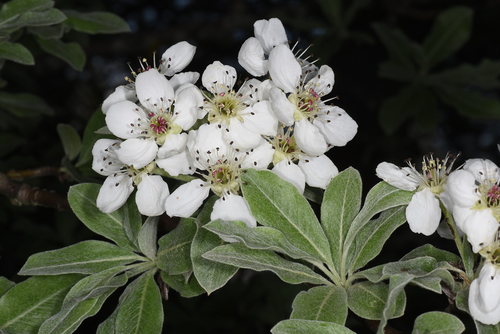
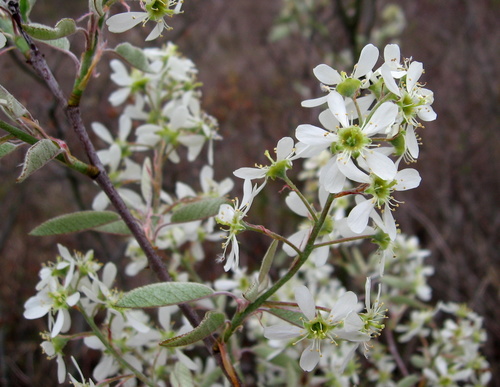
Amelanchier canadensis (L.) Medik. is a deciduous shrub or small tree that grows 0.5 to 8 meters (1.6 to 26.2 feet) tall, with one to many stems and a narrow, fastigiate crown. Leaves grow in an alternate, simple arrangement and are shaped ovate to ovate-oblong, 1 to 5.5 cm long and 1.8 to 2.8 cm broad, with a rounded to sub-acute apex. Leaves are downy on their lower surface, have serrated margins, and are attached by an 8 to 15 mm petiole; other sources note leaves are subtly serrated and reach 38 to 64 mm (1+1⁄2 to 2+1⁄2 inches) in length. Flowers form in early spring in loose 4–6 cm long racemes at the ends of branches, with each raceme holding four to ten flowers. Each flower has five white petals 7.6–11 mm long and 2–4 mm broad, plus 20 stamens. The fruit is a 7–10 mm diameter pome that turns dark purple when ripe, with a sweet, edible taste. In its native range, fruits ripen during June and July. It ranges from 1.8 to 6.1 m (6 to 20 feet) tall when growing as a deciduous small tree. Amelanchier canadensis occurs primarily on the East coast of North America, ranging as far north as the Canadian provinces of Ontario and Quebec, and as far west as the state of Mississippi. It is used as a medicinal plant, a food source, an ornamental plant, and is sometimes grown as bonsai. Because it blooms early in spring, it is an important food source for pollinators including butterflies and honeybees. Its wood is hard, heavy, and dark brown, and it accepts polish well. The wood can be used to make fishing rods, walking sticks, and wooden handles, but commercial wood production is difficult due to the species' small size. The bark and roots of this tree have multiple medicinal uses: roots have been used to treat miscarriage, bark has been used as a dewormer for children, to make disinfectant wipes, to treat diarrhea, and to reduce excessive bleeding during menstruation.