About Amelanchier arborea (F.Michx.) Fernald
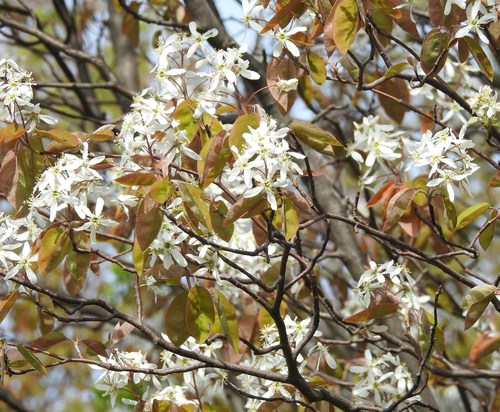
Amelanchier arborea, commonly known as downy serviceberry or common serviceberry, is native to eastern North America. Its range extends from the Gulf Coast north to Thunder Bay in Ontario and Lake St. John in Quebec, and west to Texas and Minnesota. Additional common names include shadberries (named because its blooming aligns with shad runs in New England), Juneberries (named because berries typically develop in June), and Service or Sarvice berries. The name Service berry comes from the observation that its blooming signals that muddy back roads into Appalachian coves and hollers will soon be passable for circuit-riding preachers, allowing communities to hold Sunday services again. A more morbid explanation of the name notes that blooming indicates the ground has softened enough to dig, meaning people who died over winter can be buried and have funeral services held for them. Amelanchier arborea typically grows 5–12 m (16–39 ft) tall, and occasionally can reach up to 20 metres (66 ft) tall to enter the forest overstory. Its trunk can grow up to 15 cm (6 in) in diameter, rarely reaching 40 cm or 16 in. The bark is smooth and gray. The buds are slender with a pointed tip, and usually have more than two scales visible. The leaves are ovate or elliptical, 4–8 cm (1+1⁄2–3+1⁄4 in) long (rarely 10 cm/4 in) and 2.5–4 cm (1–1+5⁄8 in) wide, with pointed tips and finely serrated margins. A key identification characteristic is that young emerging leaves are downy on the underside. Fall foliage color varies from orange-yellow to pinkish or reddish. It produces perfect flowers that are 15–25 mm (5⁄8–1 in) in diameter with 5 white petals, that emerge during budbreak in early spring. Flowers grow on pendulous racemes that are 3–5 cm (1+1⁄4–2 in) long, with 4–10 flowers per raceme. Bees pollinate the flowers. The fruit is a reddish-purple pome shaped like a small apple. The fruit ripens in summer and is very popular with birds. More than 40 species of birds and various mammals eat the fruit, including squirrels, rabbits, chipmunks, mice, voles, foxes, black bears, deer, and elk. Amelanchier arborea commonly hybridizes with other Amelanchier species; the hybrid Amelanchier × grandiflora is one example, and this tendency to hybridize makes identification of the species very difficult. In cultivation, this species tolerates a range of light levels but grows best in full sun. It requires good drainage and air circulation, and should be watered during drought. It is often confused with other species in the nursery trade. It can be propagated by seed, division, and grafting. Its edible fruit is drier than the fruit of some other serviceberry species. It is harvested locally for use in pies and jams, and is also known to be used to make wine. Native Americans historically used the fruit to make bread. Some sources note that sweetened juice from the fruit tastes like Dr. Pepper, and some nurseries sell the plant as "The Dr. Pepper Tree", but the fruit is not used in making the commercial soft drink.