About Amegilla chlorocyanea (Cockerell, 1914)
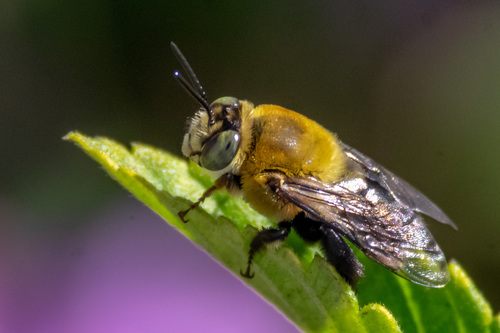
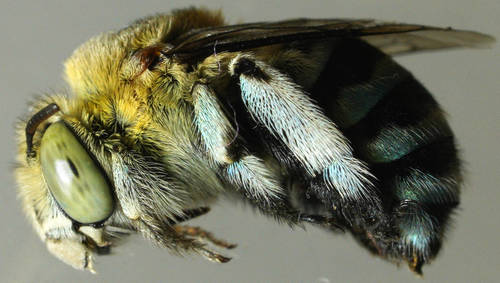
Males of Amegilla chlorocyanea are approximately 11mm long, while females are a little larger at around 13mm. This species has large grey-green eyes, black antennae, and a long tongue. The labrum, mandibles, and supraclypeal areas are pale yellow. The clypeus bears a pale yellow upside-down T-shape, which forms two black facial stripes that are much wider on females. The areas around the eyes are black and covered in predominantly pale yellow hair. Thoracic hair is mostly ginger or brown on the upper surface, and white underneath. The metasoma has white hair bands with metallic blue-green iridescence, though around 10% of specimens have orange bands instead. Females have a large pale hair spot at the end of the abdomen, with a hairless black triangle just above this spot. Males have black hair notches at the end of the abdomen. On the legs, the hair closest to the body is black, while outer leg segments bear mostly white hair. The outer leg hairs have blue-green iridescence, which is a diagnostic feature of the species, though it is not always visible in photographs. Females have a short black streak of hair on the hind leg, which males do not have. Amegilla chlorocyanea is endemic to Australia, found across the Australian mainland, particularly in arid and temperate areas. It has also been recorded on several offshore islands, including Kangaroo Island, Barrow Island, Enderby Island, and the Neptune Islands. One specimen was collected in Tasmania in 1948, but this is thought to be from a failed introduction. This is a solitary bee species, though females generally nest in groups. Nests are dug in sheltered positions in the ground, and reach up to 100mm in length. Common nesting locations include creek banks, ground under houses, dry mudbanks, and old mortar or sandstone. A completed nest tunnel holds a series of cells; each cell contains a single egg laid on a mixture of nectar and pollen. Amegilla chlorocyanea is believed to be a host of the kleptoparasitic Waroona cuckoo bee. In southern Australia, A. chlorocyanea is active during warmer months, with peak activity around January. In northern Australia, it is active year-round, with activity peaks in May and October. This bee visits flowers of both native and introduced plants from a wide range of plant families, and it is a buzz pollinator. The native plant genera and species it is most frequently recorded visiting include Eremophila sp., Ptilotus sp., Stemodia florulenta, Solanum sp., Dianella sp., Goodenia sp., and Scaevola sp. It is regularly observed visiting common garden plants and weeds, specifically English Lavender (Lavandula angustifolia), Duranta erecta, and Lantana camara.