About Ambystoma rosaceum Taylor, 1941
Species Introduction
The Tarhumara salamander (Ambystoma rosaceum Taylor, 1941) is a medium-sized salamander.
Body Size Measurements
Its maximum snout to vent length is approximately 80 mm (3.1 in), with an average tail length of about 73 mm (2.9 in). Females have longer bodies and shorter tails than males.
Larval Coloration
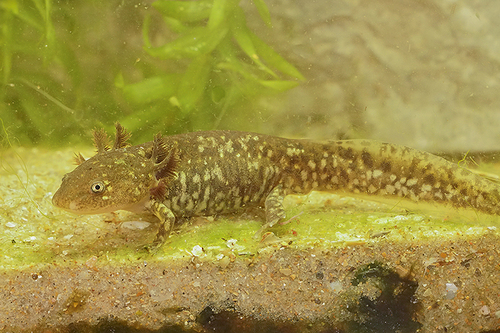
Newly-hatched larvae are uniformly brownish-black, while older larvae develop rows of yellow and black mottling.
Adult Coloration
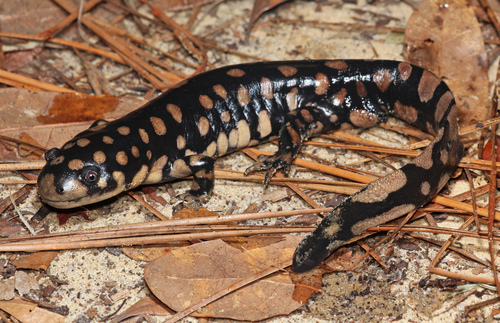
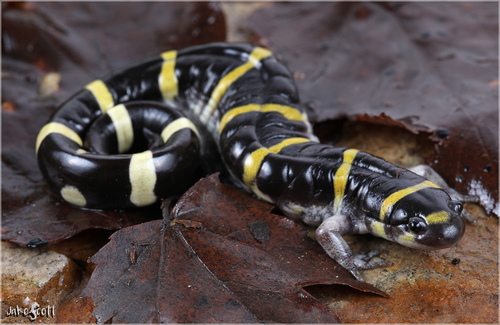
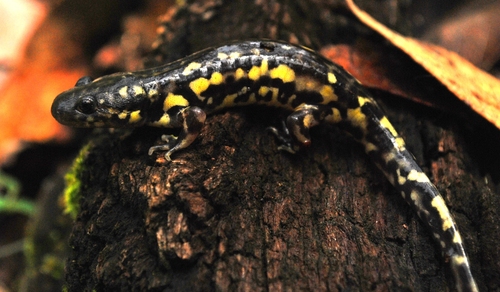
Most terrestrial adults have large yellow spots or streaks on a dark background, though some adults have plain coloration.
Paedomorphism Trait
Some individual Tarhumara salamanders are paedomorphic: they do not complete metamorphosis into the terrestrial adult form, and instead remain as aquatic, gilled paedomorphs.
Paedomorphism Habitat Context
Paedomorphosis occurs most often in montane streams and ponds.
Mexican Distribution
This species is endemic to Mexico, where it lives in the Sierra Madre Occidental mountain range at elevations between 1,675 to 3,100 metres (5,495 to 10,171 ft) above sea level.
Arizona Distribution and Threat
It can also be found in parts of Arizona, specifically in the Huachuca Mountains within the Coronado National Forest, where the species is threatened by a border barrier.
Forest Habitat
It is an adaptable species that generally inhabits pine and pine-oak forests near small, slow-moving streams, springs, or ponds.
Additional Habitats
It can also be found in thornscrub and tropical deciduous forest in some locations, as well as on farms and ranches, where it sometimes breeds in cattle ponds.