About Ambrosia trifida L.
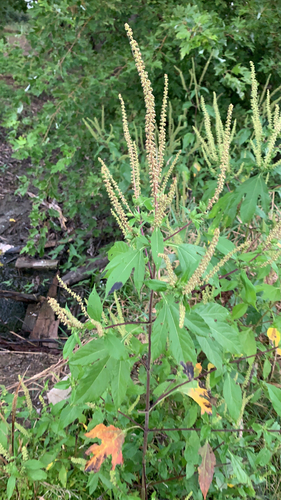
Ambrosia trifida L. is an annual herb that typically grows up to 2 meters (6 feet 7 inches) tall, though it can reach over 6 meters (20 feet) when growing in rich, moist soil. Its tough stems have woody bases, and may be either branching or unbranched. Most leaves are arranged oppositely on the stem. Leaf blades vary in shape, sometimes forming a palmate shape with five lobes, and they often have toothed edges. The largest leaves can grow over 25 centimeters (9.8 inches) long and 20 centimeters (7.9 inches) wide, and are attached to stems by petioles several centimeters in length. The leaves have a glandular, rough texture. This species is monoecious: individual plants produce inflorescences that contain both pistillate and staminate flowers. Pistillate flowers are clustered at the base of the spike, while staminate flowers grow at the tip of the spike. The fruit is a bur a few millimeters long, tipped with several tiny spines. This species is an introduced plant present in Europe and Asia, and is known as a common weed across many regions. Its common names include great ragweed, Texan great ragweed, giant ragweed, tall ragweed, blood ragweed, perennial ragweed, horseweed, buffaloweed, and kinghead. Native Americans used this plant for a variety of purposes in traditional medicine. The Cherokee used it as a remedy for insect stings, hives, fever, and pneumonia, while the Iroquois used it to treat diarrhea. It is suspected that Native Americans domesticated this plant as an oily seed crop as early as 1200 BCE, which suggests it may have been a member of the Eastern Agricultural Complex. Giant ragweed has been used successfully as a compost activator and as an ingredient in sheet mulch gardens.