About Ambrosia hispida Pursh
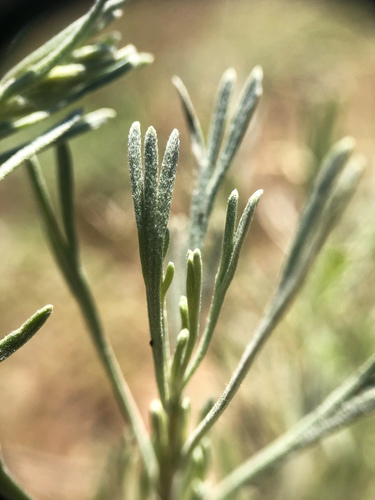
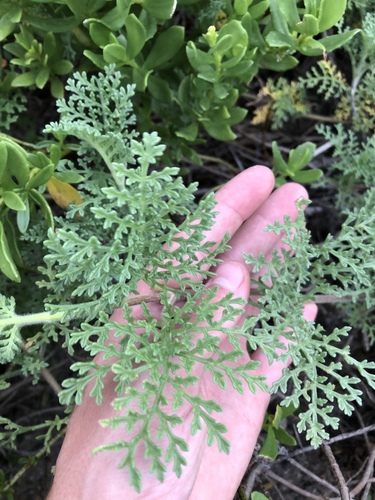
This entry describes Ambrosia hispida Pursh, a species of ragweed. Ragweeds include annual herbs, perennial herbs, and shrubs. Species within the group can reach heights ranging from just a few centimeters to over four meters. Their stems may be erect, decumbent, or prostrate, and many ragweeds grow from rhizomes. Leaves can be arranged alternately, oppositely, or with a mix of both arrangements. Leaf blades come in a wide variety of shapes, and are sometimes divided into lobes in a pinnate or palmate pattern. Leaf edges can be smooth or toothed. Some ragweed leaves are hairy, and most are glandular. Ragweeds are monoecious: most produce inflorescences that hold both staminate and pistillate flowers. Inflorescences often take the form of a spike or raceme that is made up mostly of staminate flowers, with small pistillate clusters located around the base of the structure. Staminate flower heads hold stamens surrounded by whitish or purplish florets. Pistillate flower heads hold fruit-producing ovules surrounded by many phyllaries and a smaller number of smaller florets. Pistillate ragweed flowers are pollinated by wind, after which fruits develop. The fruits are burs, which are sometimes covered in knobs, wings, or spines. Many Ambrosia species grow in desert and semi-desert areas, and many are ruderal species that inhabit disturbed habitat types.