About Ambrosia dumosa (A.Gray) W.W.Payne
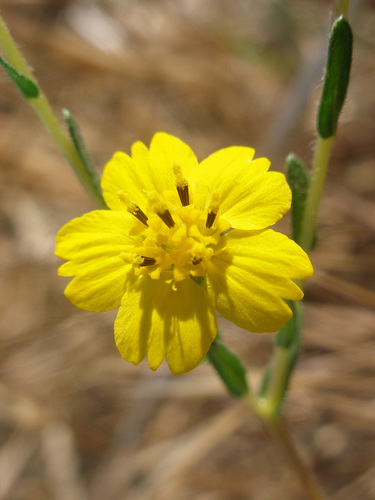
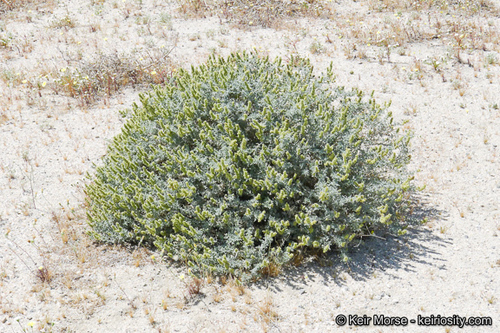
Ambrosia dumosa, commonly called white bursage, is a type of ragweed that grows as a highly branched shrub reaching 20 to 90 cm in height. Young stems of this plant are covered in soft gray-white hairs. Its leaves are roughly obovate in shape, 0.5 to 4 cm long, covered in soft gray-white hairs, and are typically 1 to 3 times pinnately compound or deeply lobed. Leaves are generally clustered on short branches. A. dumosa is monoecious, meaning it bears both staminate and pistillate flower heads on a single individual, and its inflorescence is yellow. Staminate heads hold many flowers, measure 3 to 5 mm in diameter, and have a 5 to 8 lobed involucre. Pistillate heads hold 2 flowers and do not have corollas. The plant produces spherical bur-like fruits that range in color from golden to purple to brown. Fruits are covered in microscopic hairs, and have 12 to 35 flat, straight spines 5 to 9 mm long scattered across their surface. A. dumosa is drought deciduous: it becomes dormant during drought, losing all of its leaves to reduce water loss through transpiration. Even when leafless during dormancy, it can still be identified by longitudinal stripes on its smaller stems. Like other members of the genus Ambrosia, this ragweed produces wind-blown pollen that can cause serious allergic reactions. The number of allergy cases linked to this plant is increasing in the Mojave Desert, across the range from Joshua Tree, California to Las Vegas, Nevada.