About Ambrosia deltoidea (Torr.) W.W.Payne
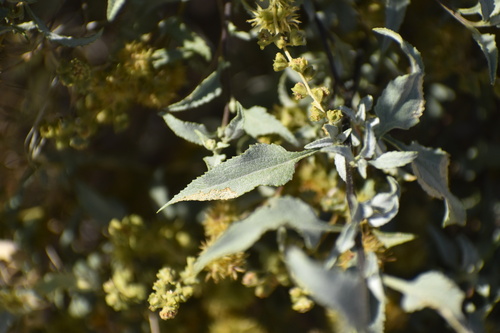
Ambrosia deltoidea is a shrub that grows from a taproot, with many lateral and adventitious roots. It produces many thin branches that reach up to around half a meter in height. The living crown of the plant generally contains many tangled dead branches, and it is drought-deciduous. Its leaves are no longer than 2 centimeters. New branches and new leaves are thinly coated with woolly fibers, and leaves become hairless as they age. Its inflorescence is a spike holding several staminate flower heads; pistillate heads often grow just below these staminate heads, and some pistillate heads are also borne on lateral branches. The fruit is a spiny-covered achene, which is most often dispersed when it sticks to animals. Observation shows the plant has a lifespan of approximately 50 years. This species is native to the Sonoran Desert region of North America. Its range covers Baja California, Baja California Sur, and Sonora in Mexico, extending north into Arizona in the United States. The shrub grows in desert habitats including desert grasslands and shrublands. It is a dominant or codominant species, and one of the most abundant plants, in the Arizona Upland Subdivision of the Sonoran Desert. While it may grow on upper and lower bajadas, it occurs most often in the ecotone between the two. It grows in open areas, and on steep, rocky slopes alongside saguaro cacti and yellow paloverde trees. Other plant species found in its habitat include condalia, ocotillo, jatropha, and prickly pears. This bursage readily invades overgrazed grassland, and areas protected from grazing contain less of this bursage. Ambrosia deltoidea acts as a nurse plant for other species: it provides shade and increased soil nitrogen for young growing plants, and also protects seedlings from herbivory. It is the main nurse plant for saguaro in Organ Pipe National Monument, and also serves as a nurse plant for yellow paloverde, ocotillo, and some prickly pear species. Most bursage individuals are associated with a perennial plant. This plant is not palatable to mammals and is not grazed by livestock. Airborne allergens from this plant can cause contact dermatitis in humans.