About Ambrosia artemisiifolia L.
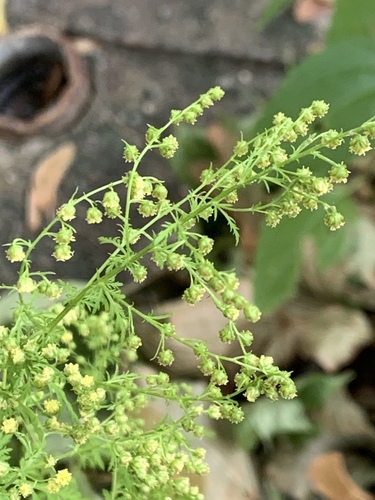
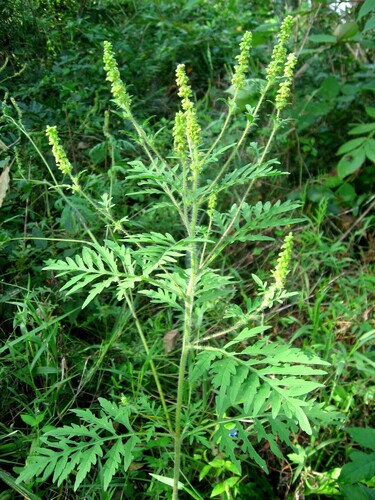
Ambrosia artemisiifolia L. is an annual plant that emerges in late spring. It reproduces via seeds, and forms many branches, reaching a maximum height of 70 centimetres (2.3 ft). Its pinnately divided leaves are soft, hairy, and grow 3–12 centimetres (1.2–4.7 in) long. In North America, this species blooms from July to October. Its pollen is dispersed by wind, and is a strong allergen for people with hay fever. It produces obconic green to brown fruit that measures 2–4 mm, and sets seed in late summer or autumn. Because its seeds persist through the winter, are produced in large numbers, and are rich in oil, they are a favored food source for songbirds and upland game birds. This species is native to multiple regions: North America across Canada, eastern and central United States, the Great Plains, and Alaska; the Caribbean islands of Cuba, Hispaniola, and Jamaica; and South America, including the southern bioregion (Argentina, Chile, Paraguay, Uruguay), the western bioregion (Bolivia, Peru), and Brazil. In North America, it is the most widespread species in the genus Ambrosia, and most other Ambrosia species are endemic to North America. Climate change is expected to drive the northward expansion of common ragweed's range in Europe in the future. During summer months, it triggers allergic reactions in susceptible people. Ambrosia artemisiifolia has a history of use as a traditional medicinal plant by multiple Native American tribes, including the Cherokee, Lakota, Iroquois, Dakota, and Delaware. Historically, the Otoe Native American tribe of the Missouri River region used this plant as a remedy for nausea. For this treatment, it was applied to the surface of the abdomen after the patient was scarified, and the area was then dressed with bruised leaves of the plant. The Houma tribe in Louisiana also used this plant to treat menstruation pain, preparing a tea from its boiled roots.