About Amblonyx cinereus cinereus
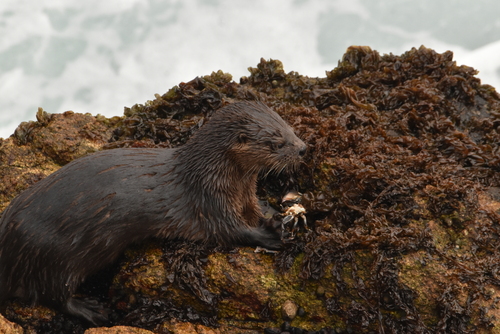
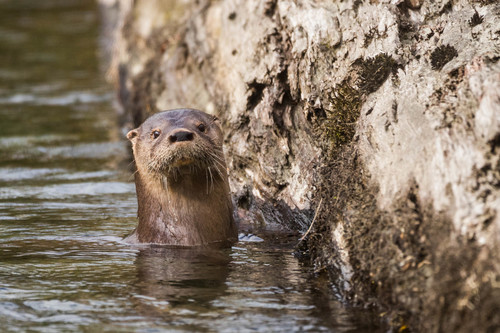
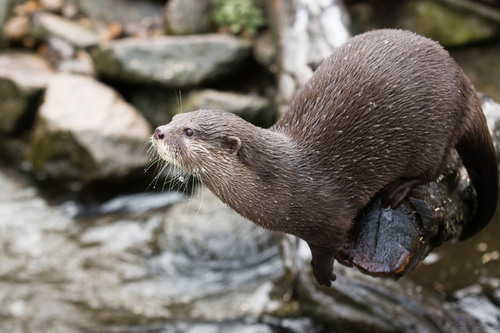
Amblonyx cinereus cinereus, the Asian small-clawed otter, is the smallest otter species native to Asia. Its fur is deep brown with a rufous tinge on the back, and is paler on the underparts. The base of its underfur is lighter in color. The sides of the neck and head are brown, while the cheeks, upper lip, chin, throat, and sides of the neck are whitish. It has a short skull, with a naked rounded rhinarium, long coarse vibrissae on either side of the muzzle, forward-placed eyes, and small oval ears with an indistinct tragus and antitragus. Its paws are narrow with short digits webbed to the last joint, and short hairs cover the lower sides of the interdigital webs. It has four-lobed plantar pads that are longer than they are wide. Its claws are short, almost erect, and may even be absent in some individuals. Females have four mammary glands. Head-to-body length ranges from 470 to 610 mm (18.4 to 24 in), with a 260 to 350 mm (10.2 to 13.6 in) long tail. The thick, muscular, tapering tail is more than half the body length, and is thickest at the base. Hind feet measure 97 to 102 mm (3.8 to 4 in) long, and skull length ranges from 84 to 94 mm (3.3 to 3.7 in). This species lacks upper premolars, and only has four upper cheek teeth. Adult captive individuals weigh between 2.7 to 3.5 kg (6.0 to 7.7 lb). The native range of the Asian small-clawed otter extends from parts of India through Southeast Asia, including the islands of Sumatra, Java, Borneo, and Palawan. Within India, it occurs in West Bengal, Assam, Arunachal Pradesh, coastal Odisha, Karnataka, and the Nilgiri and Palni hills of Tamil Nadu. In Tamil Nadu's hills, it lives in shallow mountain creeks up to an elevation of 2,000 m (6,600 ft). It inhabits freshwater wetlands including swamps, meandering rivers, and irrigated rice fields, as well as estuaries, coastal lagoons, tidal pools, and mangrove forests. In West Java, it lives along slow-flowing irrigation channels, ponds, and rice fields surrounded by sheltering vegetation. In February 2025, the species was photographed in Dadeldhura District in far-western Nepal. In the 1980s, a small number of Asian small-clawed otters escaped from captivity in England and established a wild population, which was likely eliminated following the recovery of the native Eurasian otter. The Asian small-clawed otter is primarily active after dark. It lives in groups of up to 15 individuals. Between November 2014 and March 2015, 53 individuals were recorded across 13 locations in 351 km (218 mi) of water courses in the Bangladesh Sundarbans, where group sizes ranged from one to 12 individuals. Group members communicate with at least 12 distinct calls, including a variety of yelps and whimpers, and will scream to call for help from other group members when disturbed. When swimming at the surface, Asian small-clawed otters row with their forelimbs and paddle with their hind limbs; when diving, they undulate their bodies and tails. Captive individuals swim at speeds of 0.7–1.2 m/s (2.3–3.9 ft/s). Wild Asian small-clawed otters smear their spraint at latrine sites using their hind feet and tails. Larger groups perform more smearing than groups of three or fewer individuals. The frequency of latrines with smeared scats varies across locations, indicating a preference for certain sites. Spraint smearing most likely strengthens social ties between group members and is part of territorial marking displays. The otters rest, sunbathe, and groom on grassy or sandy banks, and mostly use islands for these activities in marsh habitats. Most information on the mating and breeding behaviour of the Asian small-clawed otter comes from studies of captive populations. Captive pairs are monogamous. The female estrous cycle lasts 28 to 30 days, with estrus lasting between one and 13 days. Mating usually takes place in water. Gestation lasts 62 to 86 days, and the interval between births is at least eight months. Around two weeks before parturition, both the female and male build a nest, collecting grass, hay, or straw and carrying it into the breeding chamber. Litters contain between one and seven pups. Pups are born with closed eyes, which open during the fifth week. Newborn pups weigh 45.6 to 62.5 g (1.61 to 2.20 oz), and reach 410–988 g (14.5–34.9 oz) by 60 days of age. They begin exploring the area around the breeding den at 10 weeks old. At around three months old, they enter and paddle in shallow water guided by their mother. They become independent at four to five months old.