About Amaurornis phoenicurus (Pennant, 1769)
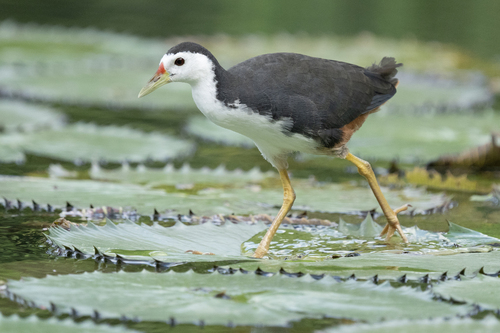
Adult white-breasted waterhens (Amaurornis phoenicurus) have mostly dark grey upperparts and flanks, with a white face, neck, and breast. The lower belly and undertail are either cinnamon or white. Their bodies are flattened laterally to make it easier to move through reeds and undergrowth. They have long toes, a short tail, and yellow bills and legs. The sexes look similar, but females are slightly smaller in size. Immature birds are much duller in color than adults. Downy chicks are black, which is consistent with all rail species. Several subspecies have been named for widely distributed populations of the species. The nominate subspecies was first described from Sri Lanka, and its range is often expanded to include the former chinensis subspecies from mainland India and adjacent Asian regions, stretching west to Arabia and east almost to Japan. The remaining subspecies are restricted to islands: insularis from the Andaman and Nicobar Islands, midnicobaricus from the central Nicobars, leucocephala from Car Nicobar, maldivus from the Maldives, javanicus from Java, and leucomelanus from Sulawesi and the Lesser Sundas. The breeding habitat of white-breasted waterhens is marshes across tropical Asia, from Pakistan east to Indonesia. They are most commonly found in the plains, but have also been recorded at higher elevations such as Nainital (1300m) and Kerala's High Range (1500m). These medium-sized rails measure 32 cm (13 in) in length, and are permanent residents across their entire range. They make short-distance movements and are known to colonize new areas; they have been recorded as one of the earliest colonizers of the volcanic island of Rakata. While they are most often found near freshwater, they also occur near brackish water and even on seashores when freshwater is unavailable, such as on the volcanic Barren Island in the Andamans. White-breasted waterhens are typically seen alone or in pairs, foraging slowly along the edges of waterbodies. They forage mostly on the ground, but will sometimes clamber up low vegetation. They hold their tails upright and jerk them as they walk. They probe for food with their bill in mud or shallow water, and also pick up food by sight. Their diet consists mainly of insects (large numbers of beetles have been recorded), small fish (which they often carefully wash in water), aquatic invertebrates, and grains or seeds, including those of Pithecolobium dulce. They may occasionally feed in deeper water, in the same manner as a moorhen. Their nesting season is mainly from June to October, though it varies across local areas. They build nests in dry locations on the ground within marsh vegetation, and lay clutches of 6 to 7 eggs. Courtship behavior includes bowing, billing, and nibbling. Eggs hatch after approximately 19 days of incubation. Both sexes incubate the eggs and care for the chicks. Chicks often dive underwater to escape predators. Adults are reported to build a roost or brood nest where adult birds and young chicks roost. While many rail species are highly secretive, white-breasted waterhens are often seen out in the open. They can be noisy, especially at dawn and dusk, producing loud croaky calls. The Andaman population insularis is reported to make duck-like quacking calls.