About Amaurornis olivacea moluccana (Wallace, 1865)
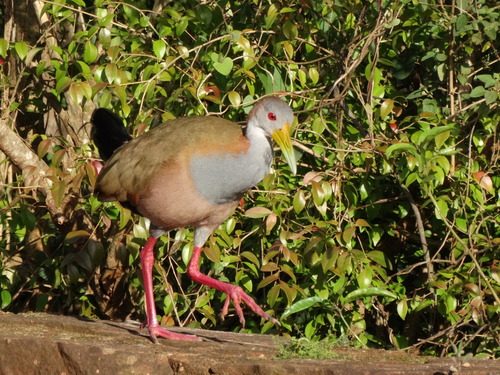
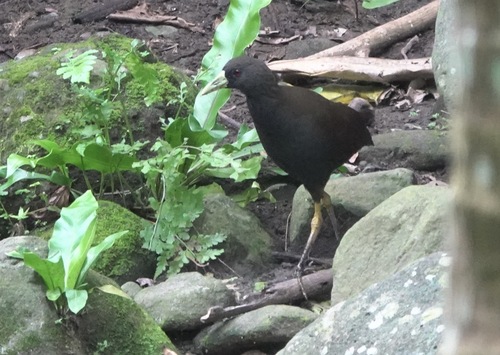
In taxonomy, Amaurornis olivacea moluccana was formerly considered conspecific with the Pale-vented bush-hen. It can be differentiated from the Pale-vented bush-hen by its darker plumage and an average slightly larger body size, though there is extensive overlap in size between the two. This taxon measures 24–31 cm in length. It has dark brown plumage on its crown, nape, back, and wings, and dark grey plumage on its face, throat, breast, and belly. Its undertail coverts are dark orange-brown, its legs are light orange-brown, and its bill is straw-yellow. This taxon is monotypic. It occupies swampy grassland, shrubland, and forest edge habitats. The International Union for Conservation of Nature has assessed it as a Least Concern species, due to its wide range, even though it is generally uncommon. It has been recommended that this assessment be updated to Data Deficient, as the taxon's ecology and population are essentially unknown. Both wetlands and forests in the Philippines, where this taxon occurs, are threatened by deforestation and land conversion. No species-specific studies have been conducted on its breeding behavior and diet, and it is presumed to share the same behavior as the Pale-vented bush-hen. It feeds on insects (mostly earthworms and larvae), small vertebrates, and vegetable matter. Little is known about its breeding, though breeding records exist for almost the entire year. It nests in swampy conditions, building a cup-shaped nest out of plant matter. It is known to lay 4 creamy white eggs marked with red spots.