About Amathuxidia amythaon Doubleday, 1847
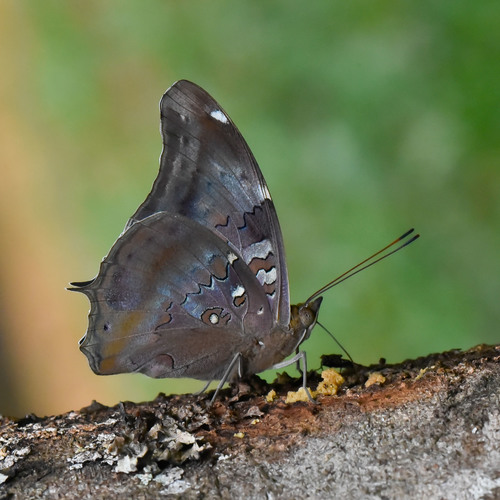
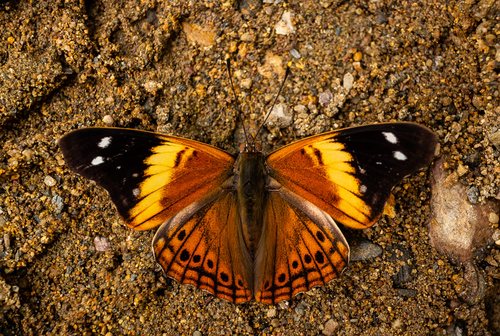
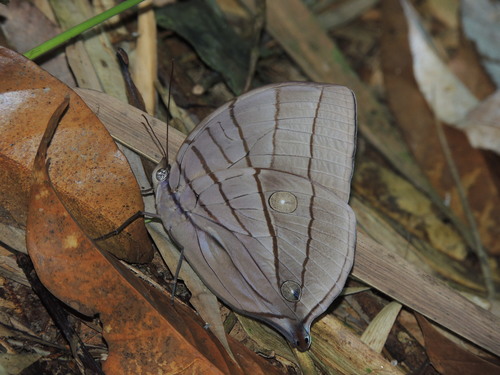
This butterfly species, Amathuxidia amythaon Doubleday, 1847, also known as the koh-i-noor, can be described as follows. For males, the upperside of the wings is brownish black with white cilia. A broad pale blue discal band stretches from the costa to near the apex of vein 1 on the forewing. The hindwing is uniformly colored with no markings. The underside of both wings is pinkish buff, crossed by multiple dark brown lines that appear on both the forewing and hindwing: a basal line that extends just beyond the middle of vein 2 on the hindwing; a subbasal line that runs from the forewing's subcostal to the hindwing's median vein; a discal line from the forewing's costa to near the hindwing's tornus; a postdiscal line from the forewing's costa to the hindwing's tornus, which then bends upward at an angle to follow the hindwing's dorsal margin; and a subterminal line that is somewhat indistinct on the forewing, and well defined while broadening toward the hindwing's tornus. In addition to these lines, the forewing has a short dark brown line crossing the cell near its apex, plus a dark brown discal line running from the costa to vein 2. The hindwing has a large ochraceous postdiscal ocellus in interspace 2, and another in interspace 6. The antennae are brown, while the head, thorax, and abdomen are dark brown. Male sex marks consist of a patch of specialized scales in the cell that extends into interspaces 1 and 2, plus a glandular fold near the base of a vein with a stiff brush of hairs beneath it. Females have an umber brown upperside. The forewing has a band matching the position of the male's pale blue band, but this band is bright yellow, narrower, and extends all the way to the tornus. Its inner margin is very irregularly zigzag and sinuous, with a spot below it in the middle. The female's hindwing is uniformly colored, with a bright yellow apex. The underside of the female's wings matches that of the male, but has a paler ground color. In terms of distribution, the koh-i-noor occurs in India from Sikkim to Assam, continuing into Myanmar. It has a wide distribution across Southeast Asia, ranging from Malaysia to the Indonesian archipelago (including Sumatra, Borneo, Enggano, and Java) and the Philippines (including Leyte, Samar, Panaon, Negros, and Mindanao). In the early to mid 20th century, William Harry Evans and Mark Alexander Wynter-Blyth reported that this butterfly is rare west of Myanmar.