About Amathusia phidippus (Linnaeus, 1763)
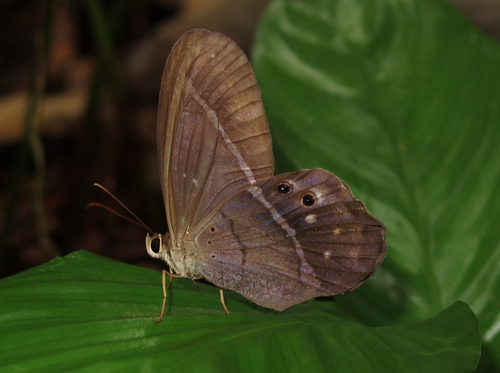
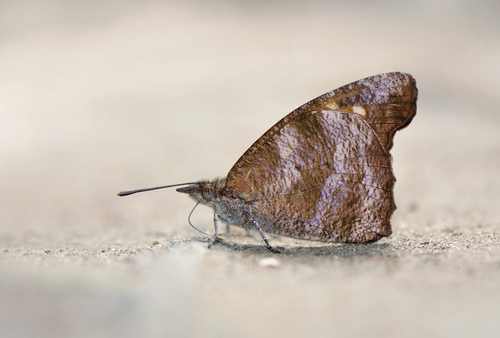
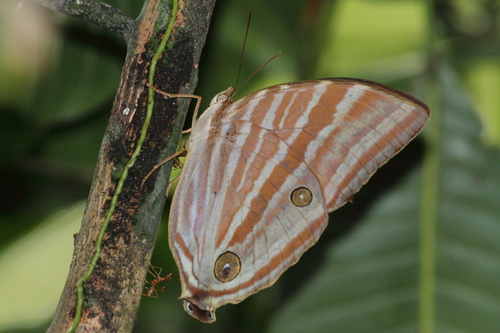
Amathusia phidippus (Linnaeus, 1763) is commonly called the palm king. Below is a detailed description of the species, broken down by life stage: Males are most easily distinguished by the umber brown color of their undersides. On the male forewing, the costal margin is narrowly fulvous (reddish brown) near the apex; this color extends toward the termen, forming an obscure preapical band that joins a subterminal lunular band of the same fulvous color. The male hindwing is uniform in color, with a subterminal band matching the forewing’s that is straight rather than lunular. The undersides are most commonly pale brown, marked with a series of transverse pale lilac-white bands that cross both the forewing and hindwing: these are basal, subbasal, discal, postdiscal, broad subterminal, and terminal. The subbasal and discal bands are equal in width, and meet above the tornal angle in a V-shape. On the forewing, the space between these two bands holds two shorter lilac-white bands that cross the cell; on the hindwing, there is a single matching band that runs from the costa to the median vein. On the hindwing, the subterminal band bends upwards above the tornal area and continues halfway up the dorsal margin. The broadly-produced tornus has a dark brown spot. Finally, the hindwing has a large ochraceous ocellus in interspace 2, and a smaller similar ocellus in interspace 6. Male antennae are reddish; the head, thorax, and abdomen are umber brown. Males have a secondary sex-mark consisting of a glandular fold in the wing membrane, shaded by tufts of long hair along vein 1 on the upperside of the hindwing, plus preapical tufts of stiff long hairs on the abdomen. Females have upper and lower wing surfaces that are similar in pattern to males, but are paler overall. On the female upperside, the fulvous color along the costal margin widens into a preapical patch. Generally, the underside bands show through and appear as pale fulvous bands on the upperside. The wingspan of adults ranges from 112 to 122 mm. Freshly laid eggs are creamy white, with a small black spot at the center and a black circular ring. Eggs are laid in rows; at Thenmala, observers recorded two rows, one holding 15 eggs and the other holding 3. Before hatching, the entire egg changes color to black. Eggs hatch after 6 to 7 days. There are five larval instars. First instar larvae are cylindrical, and measure 0.6 to 0.8 mm long. Second instar larvae are pale greenish yellow, and measure 0.8 to 1.2 mm long. Third instar larvae are morphologically very similar to the second instar, but are longer, reaching 3 to 4 cm, and stouter. Fourth instar larvae are stouter and longer, measuring 4.5 to 5.0 cm. In the fifth instar, larvae become more brownish than greyish and measure 7.0 to 7.5 cm long. Fifth instar larvae show marked variation in their ground color, with some individuals more brownish and others more greyish. Palm king larvae are voracious feeders. Most of the time, they stay on the underside of leaves, eating starting from the leaf tip and working toward the base. According to earlier descriptions cited by Bingham: caterpillars feed on coconut leaves, are cylindrical, light brown on the upper surface; from the fifth segment to the anal segment they have rows of short fine hairs; anterior segments and the head have longer anteriorly projecting hairs; the head has a pair of lateral palmated processes; the anal segment has two backward-projecting setose processes. Their overall color is light pinkish brown above, ochraceous beneath, with dark brown lateral and dorsal lines, and a black transverse band on the third and fourth segments. The process of pupation takes around half a day, and results in a greenish, spindle-shaped pupa that is well-camouflaged among the pointed leaves of its host plant. Initially, pupae are semi-transparent, but they become more opaque over time. The pupa has veins and lines that match those of the host plant’s leaves, with all veins ending at the pointed lower end of the pupa. On the eve of adult hatching, the pupa becomes transparent, with the wings and head of the developing adult clearly visible. Adult emergence from pupation happens on the 12th and 13th day of the pupal stage. An earlier description by Frederic Moore cited in Bingham describes the pupa as green, with a bifid head, and an elongate boat shape. All observed pupae eclosed (hatched) on two consecutive days, between 8 a.m. and 9 a.m. After hatching, the adult imago rested for about an hour, then flew to rest in nearby shady bushes. This butterfly is widely distributed across parts of India, Myanmar, Indo China, Peninsular Malaysia, and Thailand. It also occurs in the Indonesian archipelago (including Sundaland, King island, Java, Bali, Sumatra, Nias, Bawean, Lombok, Natuna, Borneo, Palawan, Sulawesi, and Banggai) and the Philippines (including Bongao, Sanga Sanga, Tawitawi, Sibutu, Balabac, Negros, and Mapun islands). The palm king was first reported from Travancore, Kerala in 1891 by Ferguson, and was recently rediscovered there by C. Susanth and his team in 2007. Evans reported the species from Bassein (now Vasai-Virar, Thane district, Maharashtra), but there have been no recent confirmed sightings at this location. George Mathew and Unni Krishnan Pulikkal completed the first photographic documentation and study of all of the species’ life stages in 2008. At least on Borneo, and probably in other parts of its range, adult individuals do not generally visit carrion or old fruit to drink liquids, a trait shared with many other Morphinae butterflies.