About Amata cerbera Linnaeus, 1764
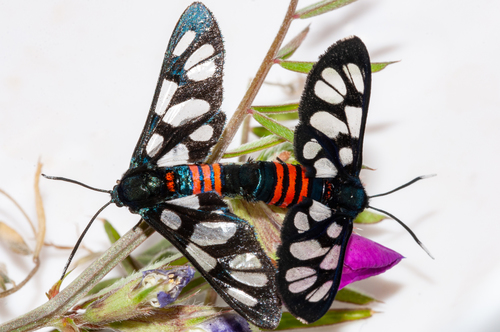
Upperside: The antennae and head are black. The thorax and abdomen are shining blueish green; the abdomen has three scarlet rings across its middle that extend from side to side, but do not meet on the underside. The anterior wings are dark green, with six glass-like transparent spots. The smallest spot, near the base, is round; three spots positioned next to the external margin are oblong; the remaining two spots in the middle are oval and triangular. The posterior wings are dark green, with two transparent spots; the largest is next to the shoulders, and the other, a small round spot, lies beyond the middle. Underside: The breast, abdomen, and legs are shining mazarine blue that leans toward green; there is a small red spot on the breast, close to the shoulders of the superior wings. One joint of the hinder legs is white. The wings are the same color as they are on the upperside. This species is found in Angola, the DRC, Gabon, Ghana, Guinea, Guinea-Bissau, Kenya, Malawi, Nigeria, Senegal, Sierra Leone, South Africa, Tanzania and Uganda. The larvae of Amata cerbera feed on species from the Rumex, Corylus, Plantago and Rubus genera. They have also been recorded feeding on various grasses, including Festuca and Anthoxanthum, as well as species from the Thapsia, Taraxacum, Urtica and Sonchus genera, and even on hay and paper.