About Amaranthus viridis L.
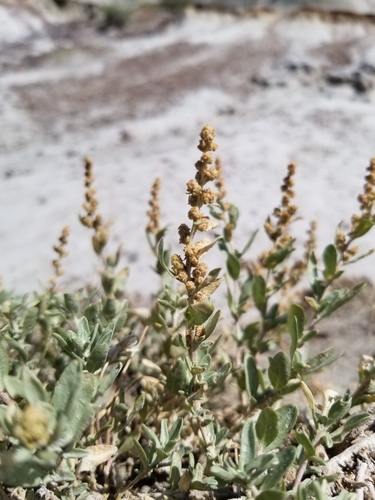
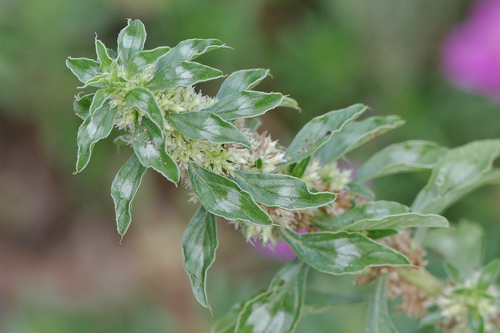
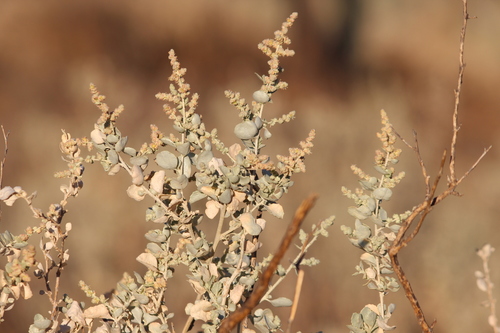
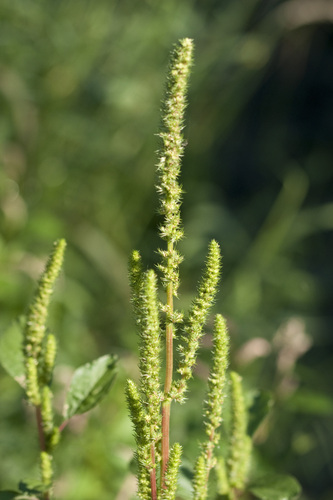
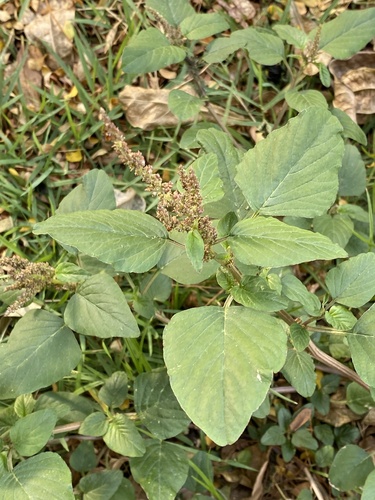
Amaranthus viridis L. is an annual herb. It has an upright, light green stem that reaches 60–80 cm in height, with numerous branches growing from its base. Its leaves are ovate, measuring 3–6 cm long and 2–4 cm wide, and grow on long petioles about 5 cm long. It produces terminal panicles with few branches, which hold small green flowers that have 3 stamens.
Across many regions of the world, Amaranthus viridis is eaten as a boiled green or cooked vegetable. In India, it has multiple regional names: it is called cheng-kruk in the Northeastern state of Manipur, khutora xak in Assam, Gandhari (or sometimes Gendhari) saag in Bihar and Jharkhand, and kuppacheera (കുപ്പച്ചീര) in Kerala, South India, where it is commonly eaten as a vegetable. In Sinhala it is known as Koora thampala (කූර තම්පලා). It is a common vegetable in Bengali cuisine, where it is called note shak — "shak" translates to leafy vegetable. In Odia cuisine, it is a very common vegetable used as Saaga, referred to as Kosila Saaga or Marshi Saag in rural areas. It is also eaten as a vegetable in parts of Africa. In the Maldives, the leaves of this plant are called massaagu in Dhivehi, and have been part of Maldivian diets for centuries, including in the dish mas huni. Among the Yoruba people of West Africa, the plant is called ewe tete, and is used for both medicinal and spiritual purposes. In 19th century Australia, A. viridis (called green amaranth) was consumed as food; botanist Joseph Maiden wrote in 1889 that it was an excellent substitute for spinach, far superior to much of the white beet leaves sold as spinach in Sydney, that it was most similar to boiled young nettle leaves (used as food in England), that it should be cooked the same way as spinach, and that it would likely become popular as it became better known, except among people who considered it beneath their dignity to eat such a common weed.
Green amaranth also produces clusters of nutty-flavored edible seeds. These seeds can be eaten as a snack, used in baking biscuits, or boiled in water to make porridge. Unlike seeds of other amaranth species, the seeds of Amaranthus viridis can be easily harvested by scraping ripe seed spikes between the fingers. Amaranthus viridis is also used as a medicinal herb in traditional Ayurvedic medicine, where it is known by the Sanskrit name Tanduliya.