About Amaranthus caudatus L.
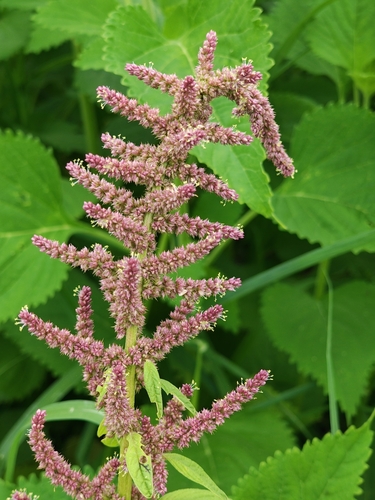
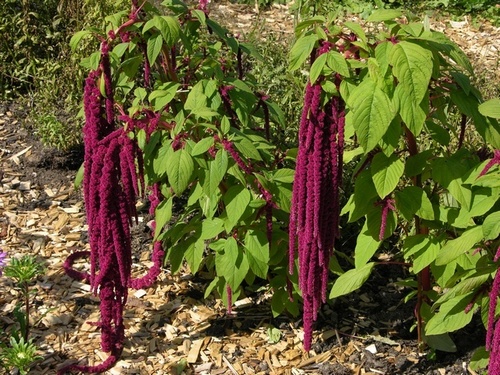
Amaranthus caudatus L. is most recognizable for its striking flowering panicles that can reach up to 90 cm long. The color of these highly dense flowering panicles ranges from black to red, and is more commonly white. Red varieties of this species get their color from a high content of betacyanins. Each panicle is self-pollinating, and each fruit holds a single small seed no larger than 1 mm in diameter. Like quinoa, each seed has a shiny coat, and its embryo curves around the small endosperm. Panicles grow from lateral buds and from the main stem. This species is an annual, broad-leaved dicotyledon with a central stem that grows from a taproot system. Depending on the variety, Amaranthus caudatus can reach up to 2.5 m tall. Leaves and side branches grow outward from the central stem, and may begin growing as low as the base of the plant. Amaranthus caudatus is an indigenous crop from the high Peruvian Andes that has been cultivated for thousands of years by many cultures including the Incas. It is the only Amaranth species that can grow at altitudes greater than 2,500 meters above sea level. Even though Amaranthus caudatus was a well-adapted staple in the Andean region for millennia and provided substantial nutritional advantages to native people, Spanish colonizers arriving in the 1500s replaced its cultivation with wheat and barley. However, due to its great nutritional content, Amaranthus caudatus is regaining popularity and returning to compete with modern crops. While it is seldom recognized outside of the Andes, significant plantings have been documented in Mexico, China, Nepal, India and Kenya. In most parts of its growing range, Amaranthus caudatus easily grows between 1 and 2.5 meters tall, grows best in full sun, and completes growth within 4–6 months. In some highland regions, it can take up to 10 months to reach maturity. It is a summer annual C4 plant. It grows from Ecuador to northern Argentina, mostly in mild areas or in the valleys of the Andes. Despite its broad geographical adaptability, it is a short-day plant and requires adequate moisture. It can be cultivated at up to 3100 m above sea level, and once established it is drought tolerant and can tolerate both wet and dry conditions. When grown in subtropical climates, it can be harvested up to two times. Loam and loam-sandy soils with plenty of organic matter and good drainage are best for cultivation; clay soils are not recommended for Amaranthus caudatus. The soil pH must be between 6-7, though the plant can still grow at a pH of up to 8.5. This crop is planted either by transplanting grown seedlings into fields, or via direct drilling at the start of the rainy season. Plants are cut at a height of 10 to 55 cm, and cultivation practices are similar to those of corn: they include management for ear emergence, two-stage fertilization, and weed control. In the Andes of Peru, Bolivia, Ecuador and Argentina, the plant is grown traditionally on non-irrigated land without fertilizers. The seeds are very small, so proper soil preparation like breaking up clods and tilling the soil is important. It is recommended to plough the soil, harrow it, and create furrows either traditionally with a yoke or by machine. Weed control is done manually by pricking out young weeds. When there is no rain, irrigation is necessary every 30 days, and this is especially critical during the flowering and grain filling stages. Harvesting is done before the plant reaches full maturity. For harvest, plants are cut 50 cm above the ground. They are gathered in furrows to dry, then beaten with sticks. They are placed on cloth or tamped floors for threshing, then sieved to separate seeds from dead leaves. Improved cultivation methods involve proper soil preparation and direct sowing of selected seeds at a density of 4 to 6 kg/ha in 80 cm wide furrows, with fertilizer applied based on the soil’s existing nutrient content. Yields range between 2000 and 5000 kg/ha in Peru, and 900 to 4000 kg/ha in Ecuador. Amaranthus caudatus, known locally as kiwicha, has several culinary uses. When ground, it can be made into flour, and when crushed it can be used as a breading for sweets and main dishes. The seeds can be popped like popcorn in a pan, and like oats, can be eaten with milk as cereal. In Mexico, it is used to make a sweet with honey called "alegría", meaning "happiness" in Spanish. India has a similar dish called ladoos. Amaranthus caudatus is slowly becoming more common outside of Latin America. Cookies and other breakfast foods made from kiwicha can be found in stores in the United States, for example. While kiwicha is gluten free, adding kiwicha flour to wheat when producing leavened bread increases the bread’s nutritional value. As a flour, Amaranthus caudatus is also used to make pasta and noodles. Today, due to its nutritional value, scientists have explored substituting amaranth leaves for other vegetables in Kenyan traditional dishes, and have studied whether vitamins and minerals remain in the leaves after boiling. Depending on which vegetables are included in the mix, the substitution can improve mineral and iron uptake.